🇺🇸 Abraham Lincoln — Biography, Teachings, Contributions, Failures & Achievements
👤 A Bit About Abraham Lincoln
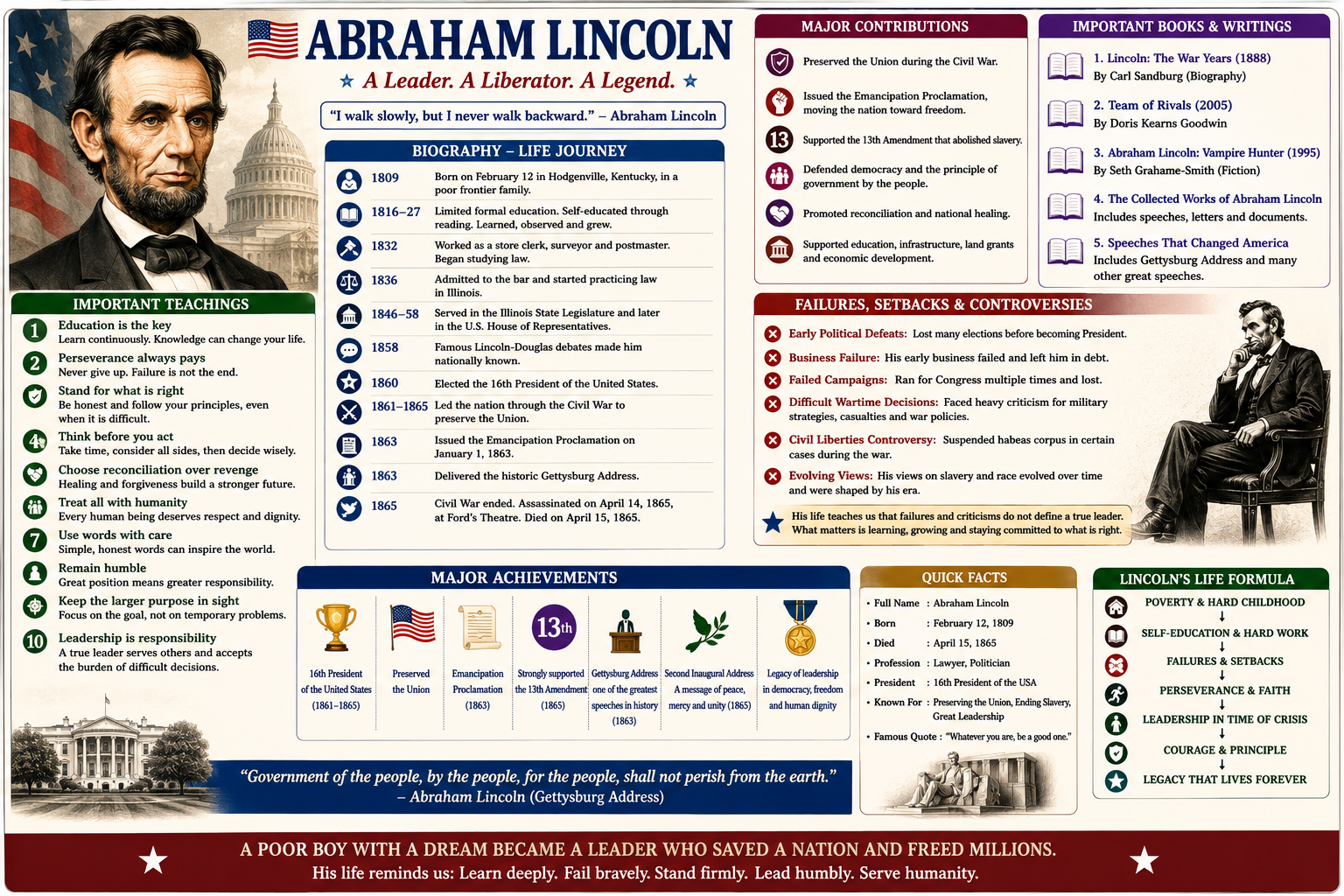
Abraham Lincoln (1809–1865) was the 16th President of the United States, serving from 1861 to 1865. He led the country through the American Civil War, preserved the Union, and took major steps toward ending slavery.
Born into a poor frontier family in Kentucky, Lincoln had very little formal schooling but became an avid reader and taught himself law. He worked as a lawyer before entering politics.
His presidency was dominated by the Civil War between the Union and the Confederacy. Lincoln’s leadership, speeches, and commitment to preserving the Union made him one of the most influential figures in American history.
He was assassinated on April 14, 1865, and died the following day.
📖 Biography — His Life Journey
🌱 1809 — Birth
Born on February 12, 1809, in a log cabin near Hodgenville, Kentucky.
📚 Childhood & Education
He grew up in modest circumstances and received limited formal education. He developed his knowledge largely through self-study and reading.
⚖️ Lawyer
Lincoln became a successful lawyer in Illinois, developing a reputation for reasoning, storytelling, and public speaking.
🏛️ Political Career
He served in the Illinois state legislature and later in the U.S. House of Representatives.
🎤 1858 — Lincoln-Douglas Debates
His debates with Stephen A. Douglas made him nationally prominent, particularly because of his opposition to the expansion of slavery.
🇺🇸 1860 — President
Lincoln was elected the 16th President of the United States.
⚔️ 1861–1865 — Civil War
Soon after his inauguration, several Southern states seceded, leading to the American Civil War.
✊ 1863 — Emancipation Proclamation
Lincoln issued the Emancipation Proclamation, declaring enslaved people in areas still in rebellion to be free as of January 1, 1863. It was a major turning point in the war and transformed the conflict’s purpose.
🕊️ 1863 — Gettysburg Address
He delivered the famous Gettysburg Address, emphasizing equality, democracy, and government “of the people, by the people, for the people.”
🏁 1865 — End of the War
The Confederacy collapsed in April 1865, shortly after Lincoln began his second term.
🕯️ 1865 — Assassination
Lincoln was assassinated by John Wilkes Booth at Ford’s Theatre in Washington, D.C.
🌟 Important Teachings of Abraham Lincoln
1. 📚 Education Can Transform Your Life
Lincoln’s limited formal schooling did not prevent him from becoming a lawyer and president.
Lesson: Never use a lack of opportunity as a reason to stop learning.
2. 💪 Perseverance Matters
Lincoln experienced repeated political and personal setbacks.
Lesson: Failure is an event—not a permanent identity.
3. 🧠 Think Before You Act
Lincoln was known for carefully considering difficult decisions.
Lesson: In important situations, patience and thoughtful judgment can be more powerful than impulsive action.
4. ⚖️ Stand for What You Believe Is Right
Lincoln’s political career increasingly centred on opposition to the expansion of slavery.
Lesson: Principles matter, especially when defending them is difficult.
5. 🕊️ Choose Reconciliation Over Revenge
Near the end of the Civil War, Lincoln advocated a generous approach toward the defeated South.
Lesson: Winning a conflict is not enough; lasting peace requires reconciliation.
6. ❤️ Treat People With Humanity
Lincoln’s leadership increasingly reflected opposition to slavery and concern for human freedom.
Lesson: Human dignity should not depend on social status.
7. 🗣️ Use Words Carefully
Lincoln’s speeches were often short, clear, and powerful.
Lesson: Great communication does not require complicated language.
8. 🌱 Remain Humble
Despite becoming president, Lincoln was known for his relatively simple manner.
Lesson: Position should increase responsibility, not ego.
9. 🎯 Keep the Larger Purpose in Sight
The Civil War presented enormous challenges.
Lesson: During difficult periods, remember the larger goal rather than becoming overwhelmed by individual problems.
10. 🤝 Leadership Means Responsibility
Lincoln carried enormous responsibility during the Civil War.
Lesson: Leadership is not simply having authority; it is accepting responsibility for difficult decisions.
🏛️ Major Contributions
🇺🇸 1. Preserved the Union
Lincoln led the United States during the Civil War and worked to prevent the country from permanently splitting apart.
✊ 2. Advanced the Cause of Emancipation
His Emancipation Proclamation changed the character of the Civil War and made ending slavery a central Union war aim.
⚖️ 3. Supported the End of Slavery
Lincoln supported constitutional abolition of slavery, culminating in the 13th Amendment, which was passed by Congress in 1865 and ratified after his death.
🗳️ 4. Defended Representative Government
His speeches emphasized democracy and the principle that government should ultimately derive its legitimacy from the people.
🕊️ 5. Promoted Reconciliation
He sought to reunite the country rather than permanently punish the defeated Southern states.
🎓 6. Supported National Development
During his presidency, important legislation supporting education, infrastructure, western settlement, and economic development was enacted.
🏆 Major Achievements
⭐ 16th President of the United States
Led the country during its greatest constitutional crisis.
⭐ Preserved the Union
The United States remained a single nation after the Civil War.
⭐ Emancipation Proclamation
A landmark wartime measure against slavery.
⭐ 13th Amendment
His administration strongly supported the constitutional abolition of slavery.
⭐ Gettysburg Address
One of the most influential political speeches in American history.
⭐ Second Inaugural Address
A remarkable reflection on war, slavery, responsibility, and reconciliation.
⭐ Legacy of Leadership
Lincoln became a lasting symbol of democracy, perseverance, freedom, and responsible leadership.
⚠️ Lincoln’s Failures, Setbacks & Controversies
Lincoln’s story is inspiring partly because he did not succeed at everything.
1. 🗳️ Early Political Defeats
He lost several elections and experienced setbacks before reaching the presidency.
Lesson: Rejection does not necessarily mean the end of your journey.
2. 💼 Business Failure
As a young man, Lincoln’s business venture failed and left him with significant debt.
Lesson: Financial failure can become a learning experience rather than a permanent defeat.
3. 🏛️ Failed Congressional Campaign
His political career included unsuccessful campaigns before later success.
Lesson: A temporary defeat does not determine your ultimate potential.
4. 🧠 Difficult Wartime Decisions
Lincoln faced severe criticism over military strategy, civil liberties, casualties, and the conduct of the war.
Lesson: Leadership often means making difficult choices when every option has serious costs.
5. ⚖️ Civil Liberties Controversies
His administration suspended habeas corpus in certain circumstances and took other extraordinary wartime measures.
Lesson: Even leaders pursuing important goals must be judged carefully on how they balance security, law, and individual liberty.
6. 🌎 His Views Evolved
Lincoln’s views on race, colonization, emancipation, and equality changed over time and were shaped by the circumstances of his era.
Lesson: Intellectual growth can involve changing one’s position as understanding develops.
🔥 Lincoln’s Life Formula
POVERTY
↓
SELF-EDUCATION 📚
↓
FAILURES
↓
PERSEVERANCE 💪
↓
LAW & PUBLIC SERVICE ⚖️
↓
LEADERSHIP 🇺🇸
↓
CRISIS ⚔️
↓
COURAGE & PRINCIPLE
↓
LEGACY 🕊️
🌟 Lincoln’s All-Time Lessons
LEARN
Never stop educating yourself.
PERSEVERE
Don’t let repeated failure define you.
STAND FOR PRINCIPLES
Do what you believe is right.
LEAD WITH HUMILITY
Power should create responsibility.
SPEAK WITH CLARITY
Simple words can carry enormous meaning.
FORGIVE
Reconciliation can be stronger than revenge.
SERVE
Use your abilities for something larger than yourself.
💎 The Greatest Lesson
“Success is not the absence of failure. It is the courage to continue after failure.”
Lincoln’s life can be remembered as:
A poor boy → a self-educated learner → a lawyer → a politician who faced defeats → a president during crisis → a leader who helped preserve the Union and advance emancipation → an enduring symbol of democratic leadership.