📚 Karl Marx — About Karl Marx
👤 Who Was Karl Marx?
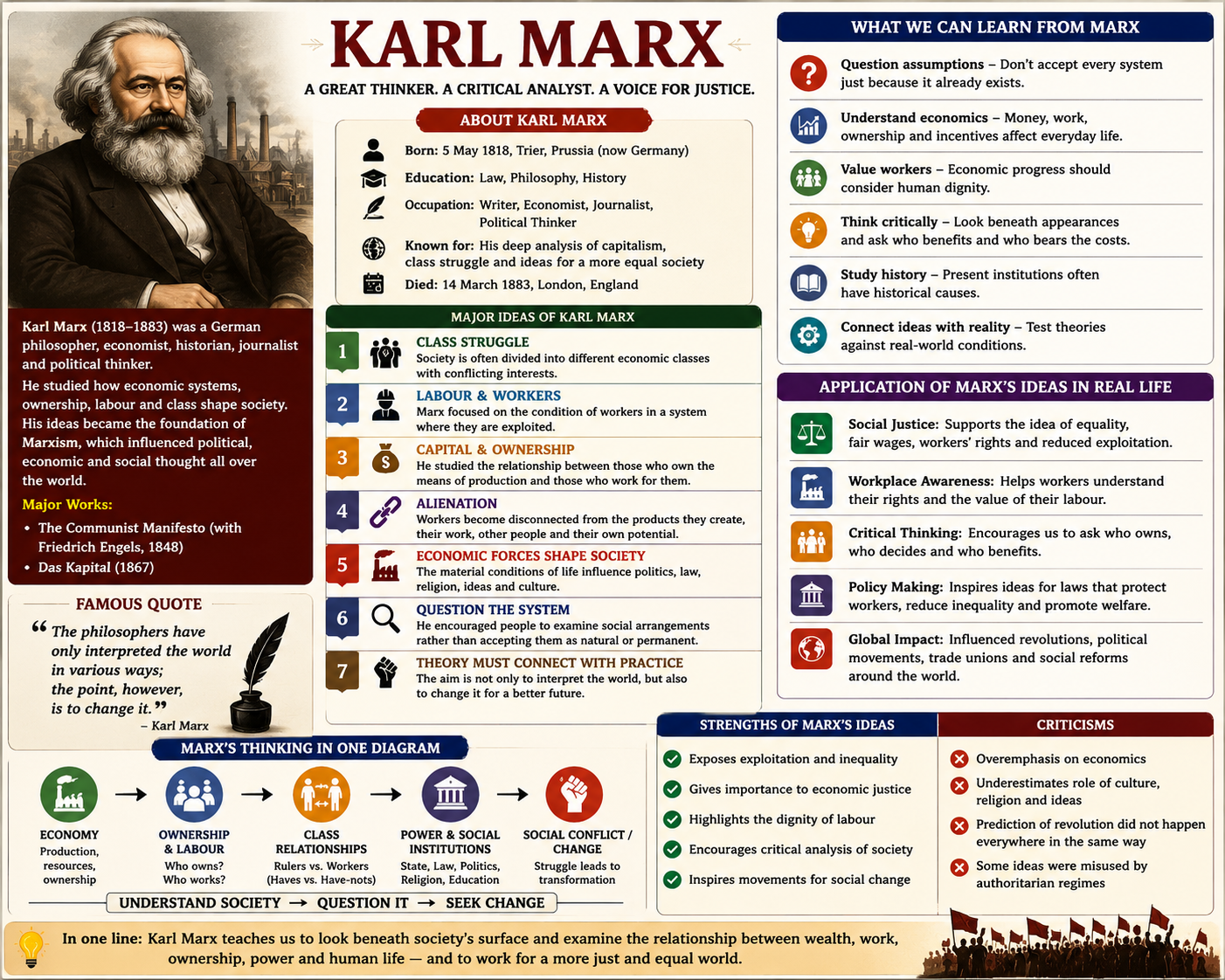
Karl Marx (1818–1883) was a German philosopher, economist, historian, journalist, and political thinker. He is one of the most influential thinkers in modern history.
He studied how economic systems, ownership, labour, and social class shape society. His ideas became the foundation of Marxism, which strongly influenced political, economic, and social thought around the world.
Marx worked closely with Friedrich Engels, with whom he co-authored The Communist Manifesto (1848). His major work, Das Kapital, examined capitalism, production, commodities, wages, and the generation of profit.
🧠 Major Ideas of Karl Marx
1. Class Struggle
Marx argued that societies often contain conflicts between different economic classes.
Key idea: Understand how economic power can influence relationships between groups.
2. Labour & Workers
Marx paid close attention to the conditions of workers under industrial capitalism.
Key idea: The dignity, conditions, and rights of working people matter.
3. Capital & Ownership
He examined the relationship between those who own productive resources and those who work for them.
Key idea: Ask who owns resources, who controls them, and how wealth is distributed.
4. Alienation
Marx argued that workers can become disconnected from the products they create, their work, other people, and their own human potential.
Key idea: Meaningful work should involve more than simply earning a wage.
5. Economic Forces Shape Society
Marx believed that the material conditions of life have a major influence on institutions and social relationships.
Key idea: To understand a society, examine its economic structure as well as its ideas and laws.
6. Question the System
Marx encouraged people to examine social arrangements rather than simply accepting them as natural or permanent.
Key idea: Ask “Why is society organised this way?”
7. Theory Must Connect With Practice
Marx was concerned not only with interpreting society but also with changing it.
Key idea: Knowledge becomes powerful when it helps people understand and improve real conditions.
🌟 Lessons We Can Take From Marx
Question assumptions → Don’t accept every system simply because it already exists.
Understand economics → Money, work, ownership, and incentives affect everyday life.
Value workers → Economic progress should consider human dignity.
Think critically → Look beneath appearances and ask who benefits and who bears the costs.
Study history → Present institutions often have historical causes.
Connect ideas with reality → Test theories against real-world conditions.
🔄 Karl Marx’s Thinking in One Diagram
ECONOMY
↓
OWNERSHIP & LABOUR
↓
CLASS RELATIONSHIPS
↓
POWER & SOCIAL INSTITUTIONS
↓
SOCIAL CONFLICT / CHANGE
↓
UNDERSTAND SOCIETY → QUESTION IT → SEEK CHANGE
💡 In One Line
Karl Marx teaches us to look beneath society’s surface and examine the relationship between wealth, work, ownership, power, and human life.