People stay busy for many reasons — to earn money, gain recognition, improve society, protect themselves, or simply feel productive. But research suggests something deeper: we dislike idleness, yet we also want a reason to stay active.
Studies from NUS, the University of Chicago, and Shanghai Jiaotong University show that people are happier when busy — even if the task is small or the reason is weak — as long as it feels justifiable.
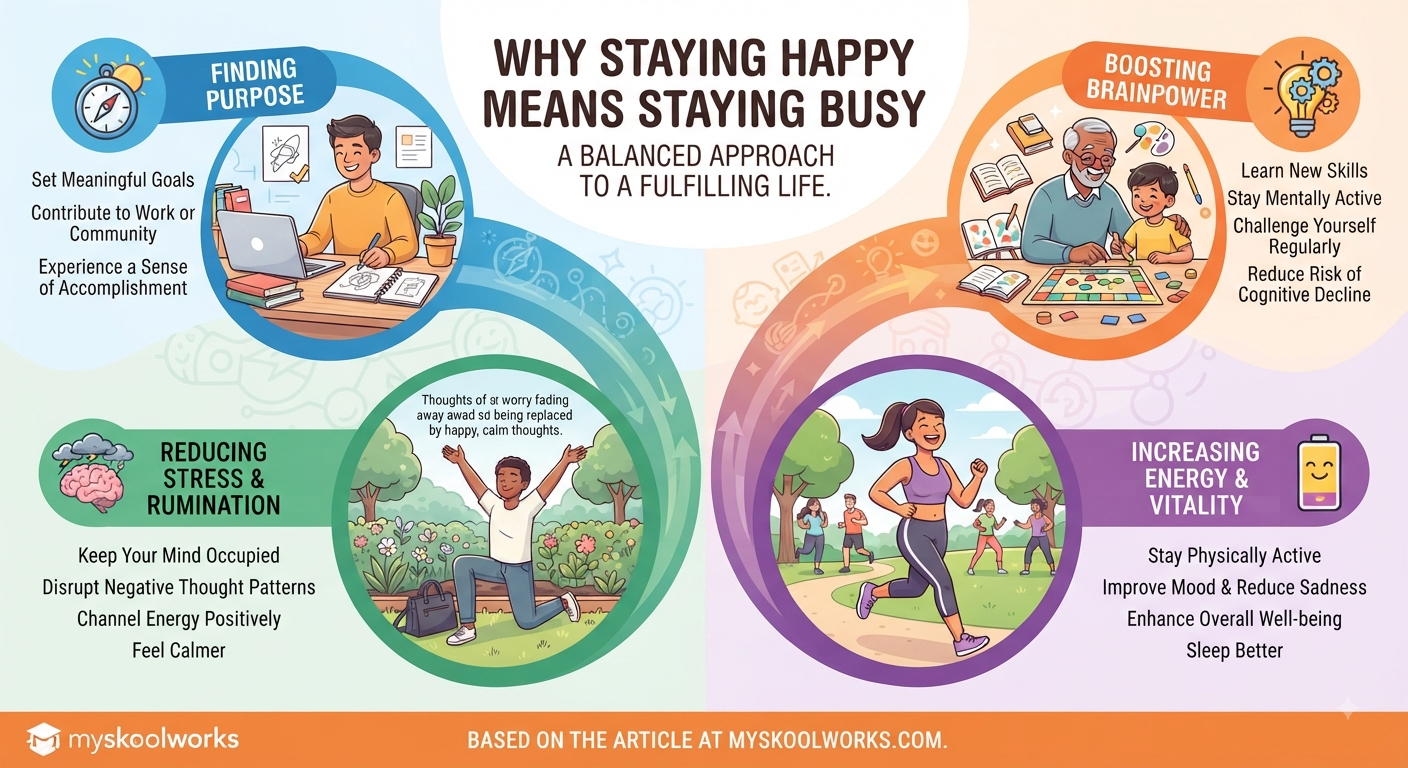
For example, airports make passengers walk farther to baggage claim to reduce idle waiting time. Experiments also showed that volunteers were happier choosing a longer walk or a simple task when they had even a small reason to justify being active.
Why this happens
Humans prefer purposeful action. Evolution likely taught us that wasting energy without reason could harm survival. So while being busy makes us feel good, we avoid activity that seems pointless.
Constructive vs. destructive busyness
Busyness can improve life — or harm it. When people lack purpose, idleness can lead to destructive behavior. As technology and automation reduce the need to work, we will have more free time than ever, making purposeful busyness even more important.
The key idea
We often say we work hard so we can rest, but research suggests the opposite may also be true: we stay active to avoid the unhappiness that comes with idleness. Time feels empty when we are idle; it feels meaningful when used toward a purpose — even a small one.