🏛️ Socrates — Biography, Teachings, Contributions, Achievements, Books, Disciples & Theories
👤 A Bit About Socrates
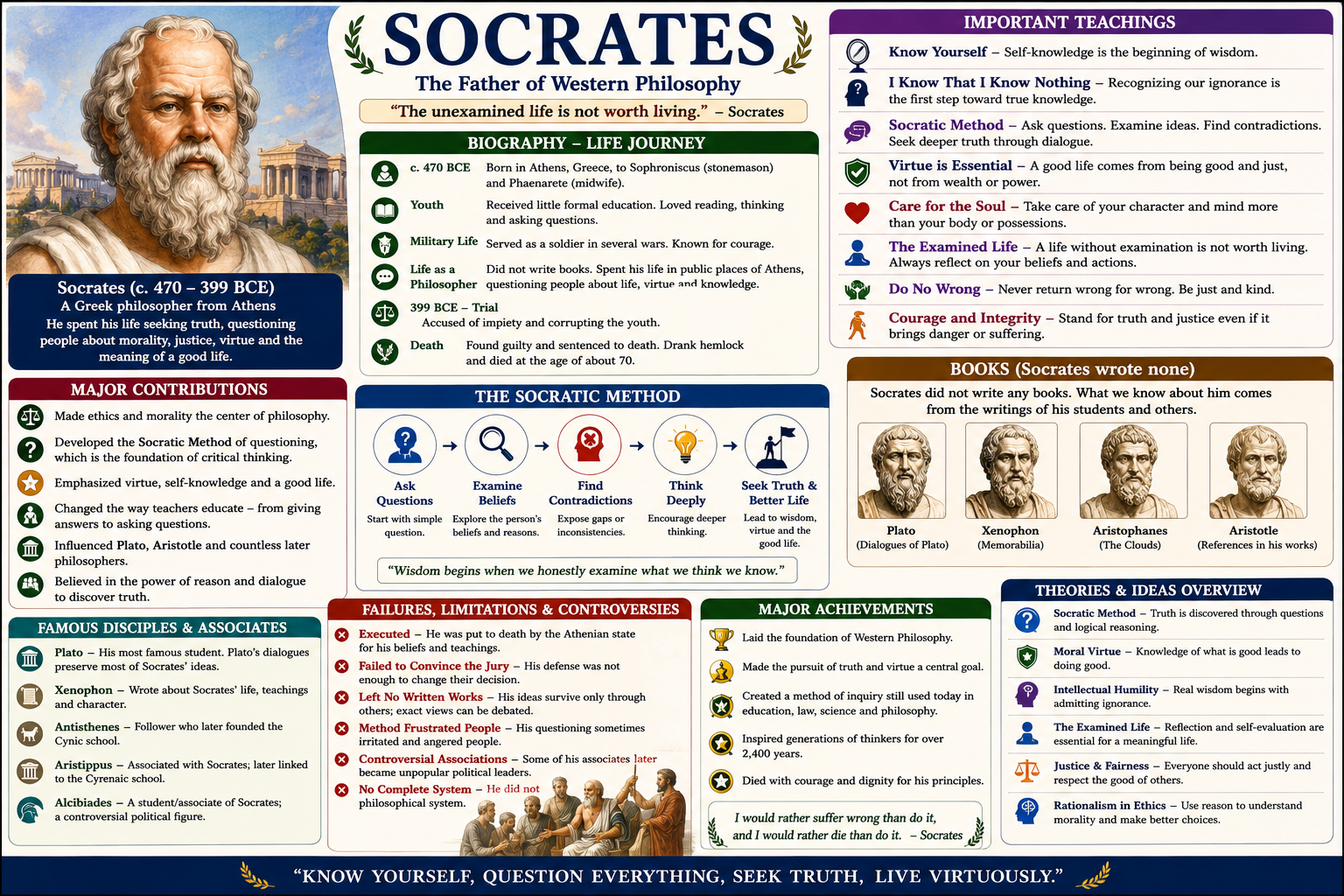
Socrates (c. 470–399 BCE) was an ancient Greek philosopher from Athens and one of the foundational figures of Western philosophy.
Unlike many philosophers, Socrates did not write books. Most of what we know about him comes from the writings of his contemporaries and students, especially Plato and Xenophon.
He spent much of his life questioning people about justice, virtue, knowledge, courage, goodness, and the meaning of a good life.
His philosophy can be summarized by one powerful idea:
🧠 “Know yourself, question everything, and live a life examined by reason.”
📜 Biography — Life Journey
🏺 c. 470 BCE — Birth
Socrates was born in Athens, Greece, around 470 BCE.
👨👩👦 Family
His father, Sophroniscus, was traditionally described as a stonemason or sculptor, while his mother, Phaenarete, was a midwife.
⚔️ Military Service
Socrates served as a hoplite soldier in several military campaigns and was known for courage and endurance.
🧠 Life as a Philosopher
Rather than establishing a formal school, he spent his time talking with people in Athens’ public spaces, questioning their assumptions.
⚖️ 399 BCE — Trial
He was charged with impiety and corrupting the youth.
☠️ Death
Socrates was found guilty and sentenced to death. He accepted the judgment and died after drinking hemlock.
He was approximately 70 years old.
📚 Did Socrates Write Any Books?
❌ No Known Books by Socrates
This is one of the most important facts about him:
Socrates wrote nothing that survives.
His philosophy was primarily communicated through dialogue and questioning.
Our knowledge of Socrates comes mainly from:
🖋️ Plato
His most famous student and the primary literary source for Socrates.
🖋️ Xenophon
A contemporary who wrote about Socrates’ life and character.
🎭 Aristophanes
A playwright who portrayed Socrates satirically in The Clouds.
📝 Aristotle
Born after Socrates’ death, Aristotle discussed Socrates’ philosophical importance and methods.
🧠 Major Theories & Ideas of Socrates
1. 🔍 Socratic Method
Perhaps his greatest contribution.
Socrates would ask a series of questions rather than simply giving answers.
Pattern:
QUESTION → EXAMINE → FIND CONTRADICTION → THINK DEEPLY → SEEK BETTER UNDERSTANDING
Application:
Instead of asking:
“What should I believe?”
ask:
“Why do I believe it?”
2. 🪞 Know Yourself
Self-knowledge was central to Socratic philosophy.
Lesson: Understand your own beliefs, weaknesses, motives, assumptions, and values.
Application:
Before judging another person, examine your own thinking.
3. 🧠 “I Know That I Know Nothing”
This famous statement captures the Socratic attitude of intellectual humility, although the exact wording is not a direct surviving quotation from Socrates.
His point was that recognizing one’s ignorance is the beginning of genuine inquiry.
Lesson:
Knowing what you don’t know is itself a form of wisdom.
4. ⚖️ Virtue Is Central to a Good Life
Socrates believed that living well depends on developing virtue and moral character, rather than merely acquiring wealth or status.
Lesson:
Being a good person is more important than merely looking successful.
5. 🧠 Moral Knowledge & Action
Socrates is associated with the view that people who genuinely understand what is good will be strongly motivated to do good.
This is often called Socratic intellectualism.
Lesson:
Understanding your values should influence your actions.
6. ❤️ Care for the Soul
Socrates emphasized caring for one’s soul or moral character more than accumulating possessions.
Lesson:
Take care of your character, wisdom, and integrity, not only your body and bank account.
7. 🏛️ The Examined Life
Socrates is famously associated with the idea that an unexamined life is not worth living.
Meaning:
A meaningful life requires reflection and self-examination.
Application:
Regularly ask:
“Why am I doing this?”
“Is this making me a better person?”
“What do I actually value?”
8. 🗣️ Socratic Irony
Socrates often presented himself as someone seeking knowledge and encouraged others to explain their beliefs.
Through questioning, he could reveal that someone who claimed to know something actually had unexamined assumptions.
Lesson:
Don’t pretend to know what you haven’t understood.
9. ⚔️ Courage Means Doing What Is Right
For Socrates, courage was not simply physical bravery.
Lesson:
True courage can mean standing by reason and principle even when doing so is personally dangerous.
10. 🕊️ Don’t Return Wrong for Wrong
Socrates argued that one should not commit injustice merely because someone else has treated you unjustly.
Lesson:
Someone else’s bad behaviour should not determine your character.
🌟 Important Teachings of Socrates
🔍 QUESTION
Don’t accept assumptions blindly.
🧠 THINK
Use reason before accepting a conclusion.
🪞 KNOW YOURSELF
Understand your own mind and character.
📚 ADMIT IGNORANCE
Recognize the limits of your knowledge.
⚖️ PURSUE VIRTUE
Character is more valuable than wealth.
❤️ CARE FOR YOUR SOUL
Develop wisdom and moral integrity.
🗣️ DIALOGUE
Learn through honest conversation.
🦁 HAVE COURAGE
Stand by truth and principle.
🕊️ DO NO WRONG
Don’t answer injustice with more injustice.
🌱 EXAMINE YOUR LIFE
Continuously evaluate how you are living.
🏆 Major Contributions
1. 🧠 Foundation of Western Ethics
Socrates shifted philosophical attention strongly toward questions about how human beings should live.
2. 🔍 Socratic Questioning
His questioning method became an influential model for education, debate, law, philosophy, and critical thinking.
3. ⚖️ Philosophy of Virtue
He made questions about justice, courage, wisdom, goodness, and morality central to philosophical inquiry.
4. 🎓 Changed the Role of the Teacher
Instead of simply delivering information, a teacher could help students discover weaknesses in their reasoning through questions.
5. 🧭 Emphasis on Moral Character
He placed greater importance on who a person becomes than on wealth, reputation, or social position.
6. 🌍 Influence on Later Philosophy
His ideas profoundly influenced Plato, Aristotle, Stoicism, Western ethics, and countless later thinkers.
👥 Famous Disciples & Associates
⭐ Plato
His most famous student. Plato’s dialogues became the major literary source for Socratic philosophy.
⭐ Xenophon
A student or associate who wrote Memorabilia, Apology of Socrates, and other works about Socrates.
⭐ Antisthenes
An associate of Socrates who later became an important precursor to Cynicism.
⭐ Aristippus
Traditionally associated with Socrates and later linked to the Cyrenaic school.
⚠️ Alcibiades
A prominent Athenian associated with Socrates, but better described as a student/associate, not simply a formal disciple.
⚠️ Failures, Limitations & Controversies
Socrates did not have a conventional career of “successes and failures,” but his life contained significant difficulties.
1. ❌ He Was Executed
His philosophical activities contributed to conflict with powerful sections of Athenian society, and he ultimately received a death sentence.
2. 🏛️ He Failed to Convince the Jury
Socrates defended himself at his trial but was found guilty.
3. 📚 Left No Written Philosophy
Because Socrates wrote no surviving books, reconstructing his exact historical views is difficult.
4. 🗣️ His Method Could Frustrate People
His questioning often exposed contradictions in people’s beliefs, which could create embarrassment or hostility.
5. ⚔️ Controversial Associations
Some people connected with Socrates, including Alcibiades and Critias, later became controversial political figures. This contributed to the complicated public image surrounding Socrates.
6. 🧩 No Complete Philosophical System
Socrates primarily questioned and examined ideas rather than leaving behind a systematic philosophical theory like later philosophers.
🏅 Socrates’ Greatest Achievement
He Made the Question “How Should I Live?” Central to Philosophy.
Instead of concentrating only on nature and the physical universe, Socrates relentlessly explored:
What is justice?
What is virtue?
What is courage?
What is knowledge?
What makes a person good?
How should we live?
🧭 Socrates’ Philosophy — One Diagram
QUESTION EVERYTHING
↓
RECOGNIZE YOUR IGNORANCE
↓
EXAMINE YOUR BELIEFS
↓
USE REASON & DIALOGUE
↓
SEEK KNOWLEDGE
↓
DEVELOP VIRTUE
↓
CONTROL YOUR ACTIONS
↓
🪞 LIVE AN EXAMINED LIFE
⭐ Socrates’ All-Time Lessons
1. Know Yourself
Self-knowledge is the beginning of wisdom.
2. Question Everything
Especially your own assumptions.
3. Admit What You Don’t Know
Intellectual humility opens the door to learning.
4. Character Over Wealth
A good life is measured by virtue, not possessions.
5. Think Before You Follow
Don’t accept popular opinion simply because everyone believes it.
6. Speak Through Reason
Arguments should be examined rather than decided by anger or authority.
7. Stand for Your Principles
Courage is remaining faithful to what you believe is right.
8. Examine Your Life
Don’t live automatically.
💎 The Socratic Life Formula
QUESTION → THINK → KNOW YOURSELF → SEEK TRUTH → BUILD CHARACTER → LIVE WISELY
🌿 The Greatest Message
Socrates teaches us that the most important education is not simply learning more facts—it is learning to examine our own thinking, understand ourselves, pursue virtue, and live according to reason and conscience.