Metacognition, it is the ability to think about your own thinking—to notice your thoughts, understand how they influence your emotions and actions, and consciously change unhelpful thinking patterns.
🧠 Metacognition: Meaning
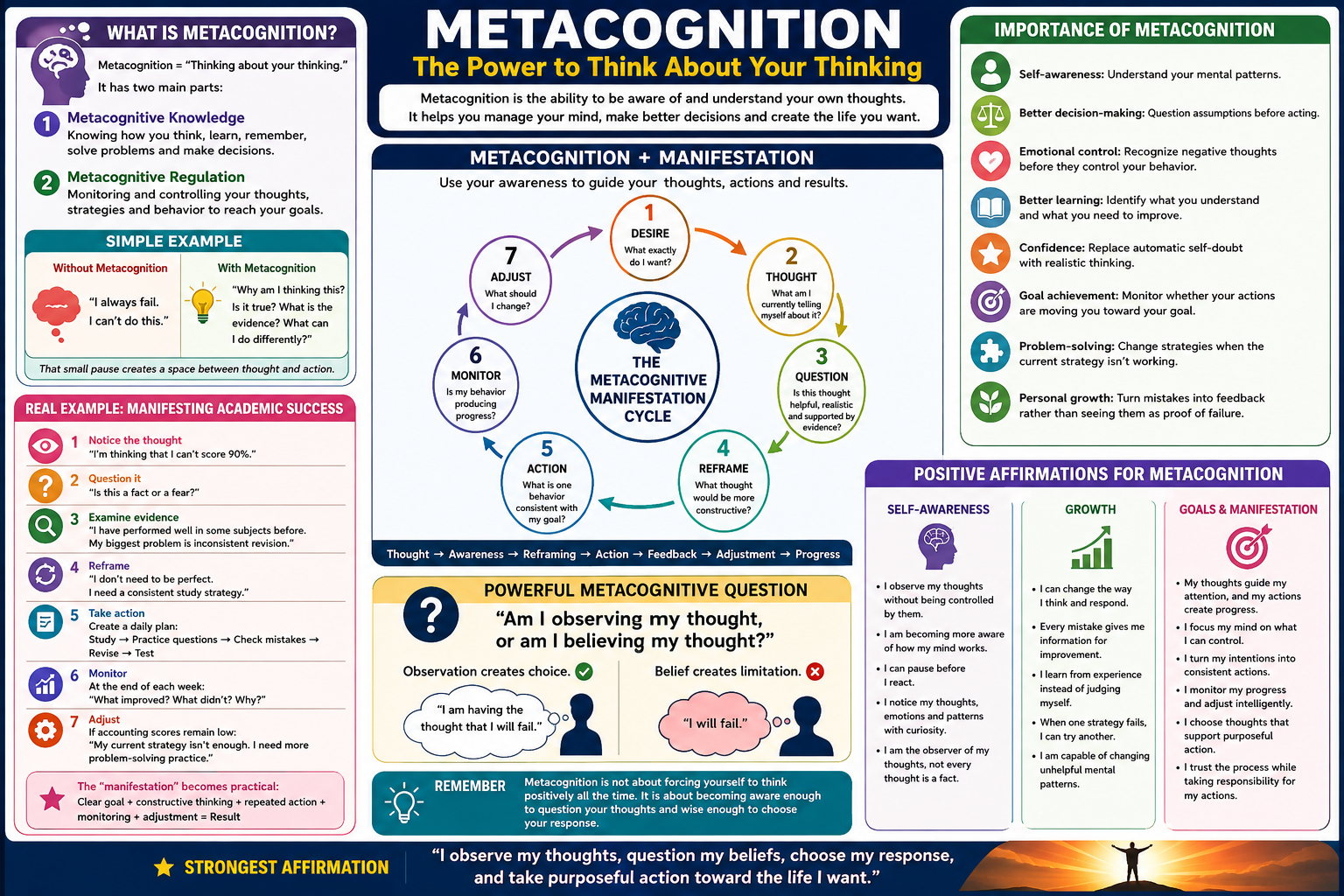
Metacognition = “Thinking about your thinking.”
It involves two main abilities:
- Metacognitive knowledge — knowing how you think, learn, react, and make decisions.
- Metacognitive regulation — monitoring and changing your thoughts, strategies, and behaviour when necessary.
Simple example
Instead of thinking:
“I always fail. I can’t do this.”
Metacognition asks:
“Why am I thinking this? Is it actually true? What evidence do I have? What can I do differently?”
That small pause creates a space between thought and action.
⭐ Importance of Metacognition
- Self-awareness: Understand your mental patterns.
- Better decision-making: Question assumptions before acting.
- Emotional control: Recognise negative thought patterns before they control behaviour.
- Better learning: Identify what you understand and what you need to improve.
- Confidence: Replace automatic self-doubt with realistic thinking.
- Goal achievement: Monitor whether your actions are moving you toward your goal.
- Problem-solving: Change strategies when the current strategy isn’t working.
- Personal growth: Turn mistakes into feedback rather than seeing them as proof of failure.
✨ Metacognition + Manifestation
A useful way to think about manifestation is not “thinking something will magically happen,” but using your thoughts to influence your attention, beliefs, decisions and behaviour.
The Metacognitive Manifestation Cycle
1. DESIRE
↓
What exactly do I want?
2. THOUGHT
↓
What am I currently telling myself about it?
3. QUESTION
↓
Is this thought helpful, realistic and supported by evidence?
4. REFRAME
↓
What thought would be more constructive?
5. ACTION
↓
What is one behaviour consistent with my goal?
6. MONITOR
↓
Is my behaviour producing progress?
7. ADJUST
↓
What should I change?
In short:
Thought → Awareness → Reframing → Action → Feedback → Adjustment → Progress
🎯 Real Example: Manifesting Academic Success
Suppose a student wants to score 90%+ in the examination.
❌ Automatic thinking
“90% is impossible for me. I’m not good at studies.”
Without metacognition, the student may accept this thought as reality and avoid studying.
🧠 Metacognitive approach
Step 1 — Notice the thought
“I’m thinking that I can’t score 90%.”
Step 2 — Question it
“Is this a fact or a fear?”
Step 3 — Examine evidence
“I have performed well in some subjects before. My biggest problem is inconsistent revision.”
Step 4 — Reframe
“I don’t need to be perfect. I need a consistent study strategy.”
Step 5 — Take action
The student creates a daily plan:
Study → Practice questions → Check mistakes → Revise → Test
Step 6 — Monitor
At the end of each week:
“What improved? What didn’t? Why?”
Step 7 — Adjust
If accounting scores remain low:
“My current strategy isn’t enough. I need more problem-solving practice.”
The “manifestation” becomes practical:
Clear goal + constructive thoughts + repeated action + monitoring + adjustment
The goal isn’t created by positive thinking alone. The thinking helps direct behaviour toward the goal.
🌱 A Powerful Metacognitive Question
Whenever you experience a strong negative thought, ask:
“Am I observing my thought, or am I believing my thought?”
For example:
“I am having the thought that I will fail.”
is very different from:
“I will fail.”
The first creates distance and choice.
💭 Positive Affirmations for Metacognition
🧠 Self-awareness
- I observe my thoughts without being controlled by them.
- I am becoming more aware of how my mind works.
- I can pause before I react.
- I notice my thoughts, emotions and patterns with curiosity.
- I am the observer of my thoughts, not every thought is a fact.
🔄 Growth
- I can change the way I think and respond.
- Every mistake gives me information for improvement.
- I learn from experience instead of judging myself.
- When one strategy fails, I can try another.
- I am capable of changing unhelpful mental patterns.
🎯 Goals & Manifestation
- My thoughts guide my attention, and my actions create progress.
- I focus my mind on what I can control.
- I turn my intentions into consistent actions.
- I monitor my progress and adjust intelligently.
- I choose thoughts that support purposeful action.
- I trust the process while taking responsibility for my actions.
🌟 Strongest affirmation
“I observe my thoughts, question my beliefs, choose my response, and take purposeful action toward the life I want.”
Remember: Metacognition is not about forcing yourself to think positively all the time. It is about becoming aware enough to question your thoughts and wise enough to choose your response.