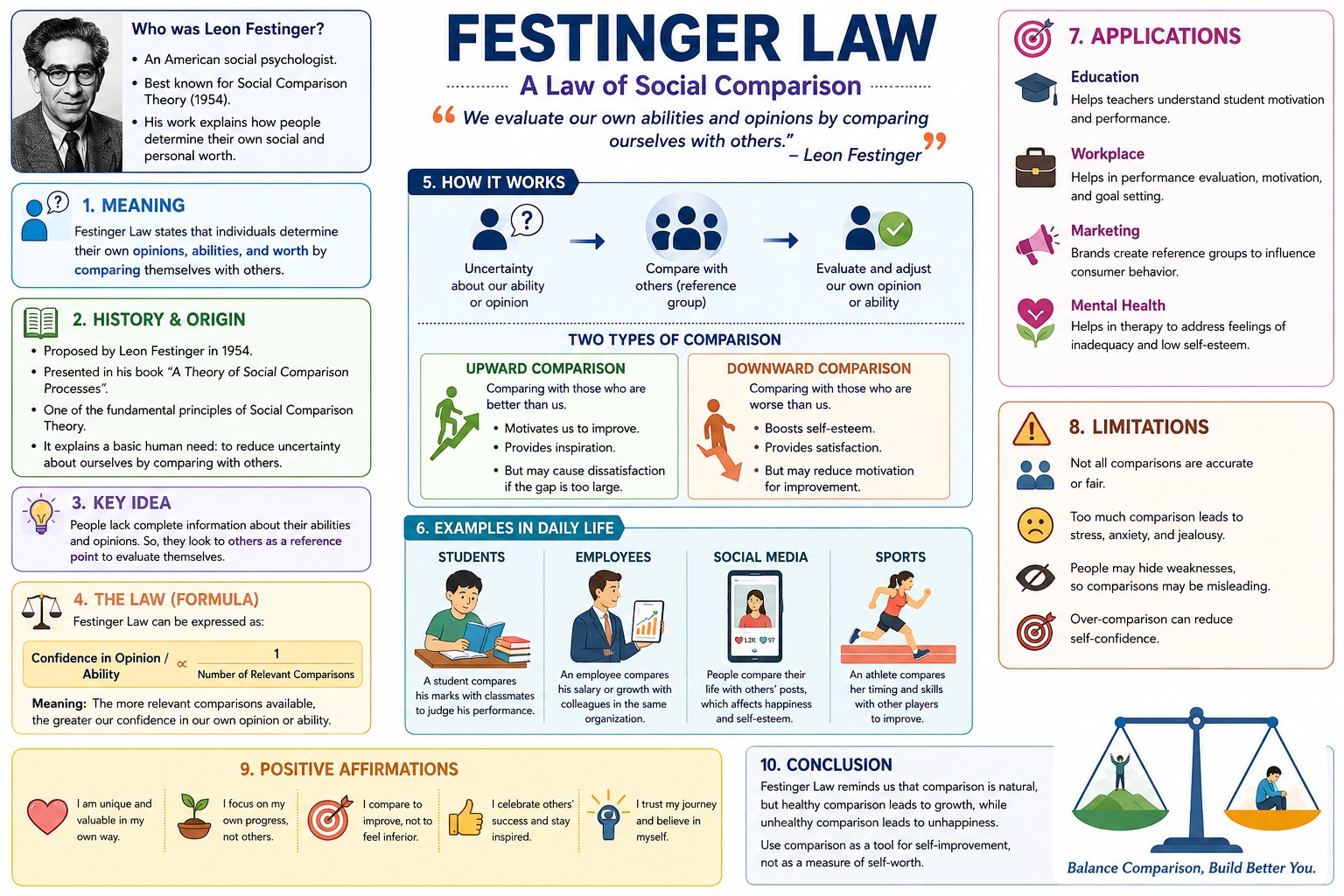
Festinger’s Law is usually called Festinger’s Cognitive Dissonance Theory. Here is the easiest way to understand it:
🧠 Festinger’s Law — In Simple Words
Main idea:
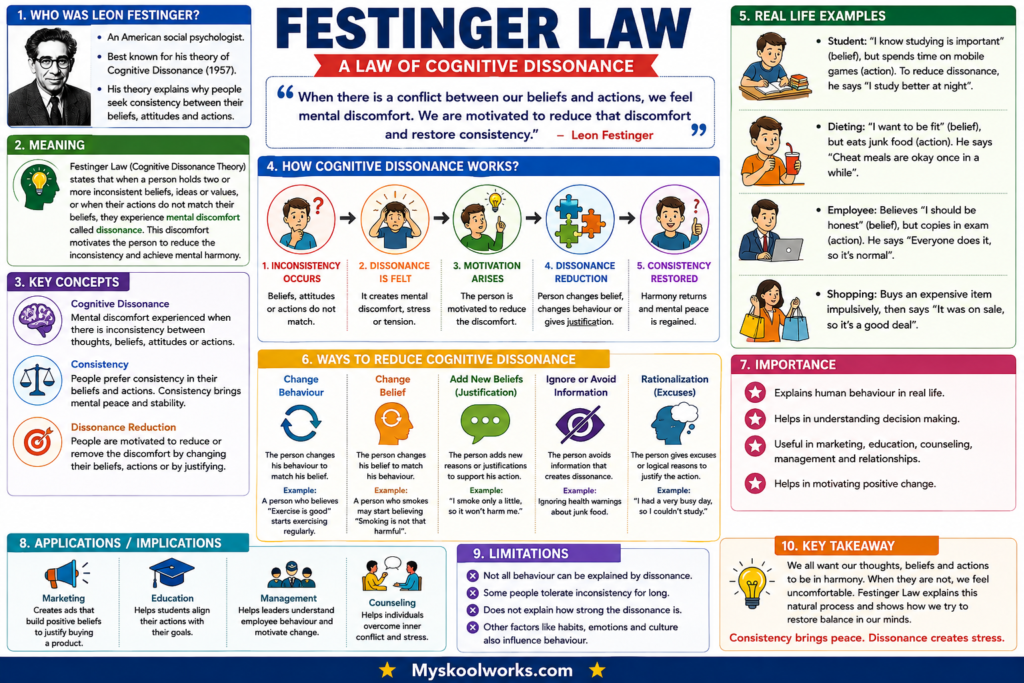
When our thoughts, beliefs and actions do not match, we feel uncomfortable inside. This mental discomfort is called cognitive dissonance.
We then try to remove that discomfort by changing our behaviour, changing our belief, or giving ourselves an explanation.
🔄 Simple Formula
Contradiction → Mental discomfort → Motivation → Change/Justification → Mental peace
📌 Easy Example: Smoking
A person knows:
“Smoking is harmful to my health.”
But he continues smoking.
So there is a conflict:
Belief: Smoking is harmful ❌
Behaviour: I continue smoking ❌
This creates mental discomfort (dissonance).
To reduce it, the person may:
- Change behaviour: Stop smoking.
- Change belief: “Smoking isn’t that harmful.”
- Justify behaviour: “I only smoke occasionally.”
- Ignore/minimize the problem: “Everyone has some bad habits.”
The person is trying to bring belief and behaviour into agreement.
🎯 Another Easy Example
You decide:
“I will study 3 hours every day.”
But instead you spend 3 hours watching videos.
Your mind says:
Goal: I should study 📚
Action: I watched videos 📱
This mismatch creates discomfort.
You may either:
- start studying,
- reduce your goal,
- or tell yourself, “I needed a break today.”
⭐ One-line definition
Festinger’s Law says that when a person’s beliefs and actions are inconsistent, the resulting mental discomfort motivates the person to restore consistency.
Easy memory trick:
👉 “Mismatch → Stress → Change → Relief.”