
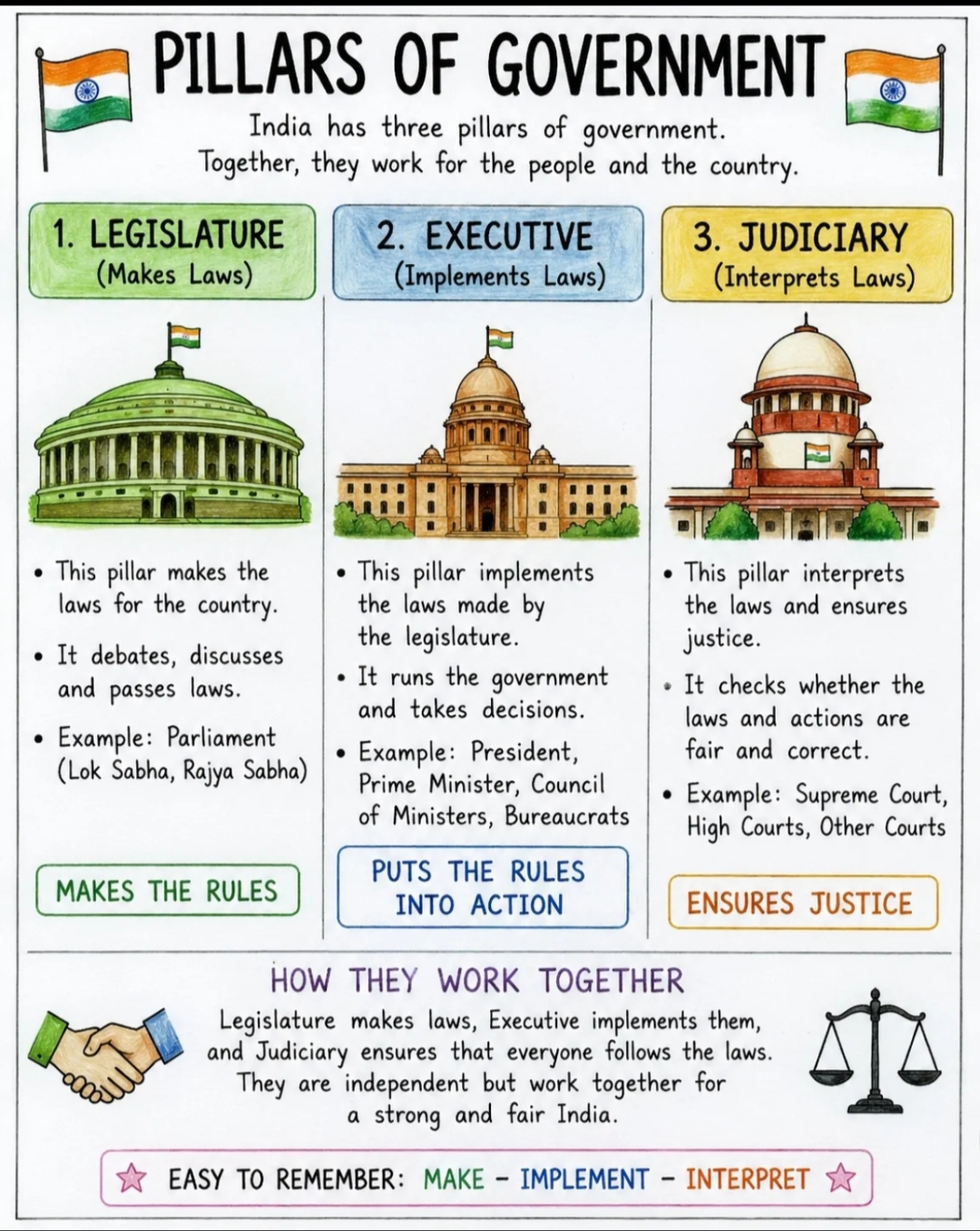
Indian Polity – System of Government
Important: This page follows the constitutional provisions and the topic structure of Chapters 13–17 supplied in the question.
A. Features of Parliamentary Government
Q1. What is the Parliamentary System? Explain its major features.
BASICThe parliamentary system is a form of government in which the executive is closely connected with the legislature and remains politically responsible to the popularly elected House.
Major features:
- Dual Executive: There is a nominal executive and a real executive. In India, the President is the constitutional head, while the Prime Minister and Council of Ministers exercise the real executive authority.
- Nominal and Real Executive: The President normally acts on the aid and advice of the Council of Ministers headed by the Prime Minister.
- Collective Responsibility: The Council of Ministers is collectively responsible to the Lok Sabha.
- Fusion of Powers: The executive is drawn from the legislature and participates in its functioning. Thus, unlike a strict separation model, the executive and legislature are closely connected.
- Prime Ministerial Leadership: The Prime Minister is the central figure of the parliamentary executive.
- Political Homogeneity: A single-party majority government generally provides greater political cohesion. In a coalition government, ministers may represent different political parties.
- Uncertain Tenure: The Council of Ministers continues as long as it enjoys the confidence of the Lok Sabha.
- Responsible Government: The executive is continuously answerable to Parliament, especially the Lok Sabha.
- Party Discipline: Political parties play a major role in maintaining legislative support for the government.
- Cabinet Government: Important policy decisions are normally taken through the Cabinet under the leadership of the Prime Minister.
B. Features of Presidential Government
Q2. What is the Presidential System? Explain its main features.
BASICIn a presidential system, the President is normally both the head of the State and the head of government. The executive does not depend upon the continuing confidence of the legislature for its tenure.
- Single executive.
- President is the real executive.
- Fixed tenure of the executive.
- Greater separation between executive and legislature.
- Ministers are generally not members of the legislature.
- Executive is not collectively responsible to the legislature in the parliamentary sense.
- President normally exercises executive authority directly or through officials responsible to the President.
C. Parliamentary vs Presidential Government
Q3. Distinguish between Parliamentary and Presidential Government.
INTERMEDIATE| Basis | Parliamentary System | Presidential System |
|---|---|---|
| Executive | Dual executive | Generally single executive |
| Real executive | Prime Minister and Council of Ministers | President |
| Relationship with legislature | Close relationship | Greater institutional separation |
| Tenure | Depends on legislative confidence | Normally fixed |
| Responsibility | Executive is responsible to legislature | Executive is not responsible in the parliamentary sense |
| Government stability | May change if majority support is lost | Generally more stable during the fixed term |
D. Merits and Demerits of Parliamentary System
Q4. Explain the merits of the Parliamentary System.
INTERMEDIATE- Responsible Government: The executive remains answerable to the legislature.
- Checks on Executive: Questions, debates, motions and parliamentary procedures provide continuous scrutiny.
- Coordination: The executive and legislature generally work in close coordination.
- Flexible Government: A government that loses majority support can be replaced without waiting for the completion of a fixed executive term.
- Representation: The Council of Ministers can include representatives of different regions, communities and political groups.
- Leadership: The Prime Minister provides political direction to the government.
Q5. Explain the major demerits of the Parliamentary System.
INTERMEDIATE- Instability: A government may fall if it loses majority support.
- Party Politics: Political considerations may influence governmental decisions.
- Possibility of Coalition Problems: Coalition governments may face disagreements among partners.
- Executive Dominance: A government with a strong parliamentary majority may dominate legislative business.
- Short-term Political Considerations: Governments may sometimes focus on immediate political gains.
E. Why Did India Adopt the Parliamentary System?
Q6. Explain the reasons for adopting the Parliamentary System in India.
ADVANCEDThe Constituent Assembly deliberately adopted the parliamentary model rather than copying the presidential model.
- Familiarity with the British Model: India had considerable experience with parliamentary institutions under the constitutional reforms introduced during British rule.
- Responsibility of the Executive: The framers preferred an executive that would remain accountable to elected representatives.
- Suitability to Indian Conditions: India’s social, linguistic and regional diversity required a system capable of accommodating different political interests.
- Prevention of Executive Dictatorship: A government dependent on legislative confidence is subject to continuing political scrutiny.
- Need for Representative Government: The system connects the executive directly with Parliament.
- Experience of Provincial Governments: India already had experience of parliamentary government under the Government of India Act, 1935.
F. Indian and British Parliamentary Models
Q7. Distinguish between the Indian and British Parliamentary Systems.
ADVANCED| Basis | India | United Kingdom |
|---|---|---|
| Constitution | Written and supreme Constitution | Uncodified constitutional system |
| Head of State | Elected President | Hereditary monarch |
| Judicial review | Strong constitutional judicial review | Different constitutional arrangement |
| Parliamentary sovereignty | Constitutional supremacy | Parliamentary sovereignty is a central principle |
| Federal structure | Federal system with strong Union features | Unitary parliamentary structure |
| Republic | India is a republic | UK is a constitutional monarchy |
A. Meaning of Federal Government
Q8. What is a Federal System? Explain the federal character of India.
BASICA federal system divides governmental powers between a central authority and regional governments. Both levels derive their authority from the Constitution and operate within constitutionally defined spheres.
India combines federal principles with strong unitary features. Therefore, India is often described as a federation with a strong Centre or a quasi-federal system.
B. Federal Features of the Constitution
Q9. Explain the federal features of the Indian Constitution.
INTERMEDIATE- Dual Polity: There are Union and State governments.
- Written Constitution: The Constitution defines the powers of both levels.
- Supremacy of Constitution: Both Union and State governments must operate within constitutional limits.
- Division of Powers: The Seventh Schedule distributes legislative subjects between Union, State and Concurrent spheres.
- Independent Judiciary: Courts can settle constitutional disputes between different levels of government.
- Bicameralism: The Rajya Sabha represents the States at the Union level.
- Constitutional Rigidity in Certain Matters: Certain constitutional amendments require ratification by at least half of the State Legislatures.
Article 246 distributes legislative competence among the Union, State and Concurrent Lists. 1
C. Unitary Features of the Constitution
Q10. Explain the unitary features of the Indian Constitution.
INTERMEDIATE- Strong Union: The Union has extensive legislative, administrative and financial powers.
- Single Constitution: The constitutional framework largely applies to both Union and States.
- Single Citizenship: India provides for single citizenship.
- Integrated Judiciary: India has a single integrated judicial system rather than separate federal and state court systems.
- All-India Services: Services such as the IAS and IPS provide an important administrative link between Union and States.
- Governor: The Governor is appointed by the President.
- Emergency Provisions: During emergencies, the federal balance can shift strongly towards the Union.
- Parliamentary Power over State Boundaries: Parliament has constitutional authority concerning the formation and alteration of States.
- Residuary Powers: Residuary legislative powers belong to Parliament.
The Supreme Court describes India as having a federal system while also emphasising the integrated judicial structure. 2
D. Critical Evaluation of Indian Federalism
Q11. Why is the Indian Constitution described as federal with strong unitary features?
ADVANCEDIndian federalism cannot be understood simply as either completely federal or completely unitary.
During normal times, constitutional powers are distributed between the Union and States. However, several provisions strengthen the Union.
The Centre has important advantages regarding residuary powers, emergency powers, financial resources, interstate coordination and national administration.
Therefore, Indian federalism is often described as:
- Federal in structure.
- Unitary in certain operational features.
- Flexible according to circumstances.
- More centralised during constitutional emergencies.
A. Legislative Relations
Q12. Explain the legislative relations between the Union and the States.
INTERMEDIATELegislative relations concern the distribution of law-making powers between Parliament and State Legislatures.
The Seventh Schedule contains:
- Union List: Parliament has exclusive competence over subjects assigned to this List, subject to constitutional provisions.
- State List: State Legislatures ordinarily have exclusive power over subjects assigned to this List.
- Concurrent List: Both Parliament and State Legislatures can legislate.
Article 246 establishes the basic distribution of legislative competence. 3
Parliament can also legislate in certain situations on matters normally falling within the State sphere, including situations involving national interest, emergencies and other constitutionally specified circumstances.
Q13. Explain the different situations in which Parliament can make laws on State List subjects.
ADVANCED- National Interest – Article 249: Rajya Sabha may pass a resolution, by the constitutionally required special majority, declaring it necessary in the national interest for Parliament to legislate on a State List matter.
- Emergency – Article 250: During a National Emergency, Parliament can legislate on State List matters.
- Request by States – Article 252: Two or more State Legislatures may request Parliament to legislate on a State subject. Other States may later adopt such legislation.
- International Agreements – Article 253: Parliament can make laws for implementing treaties, agreements or international decisions.
- President’s Rule – Article 356: During President’s Rule, Parliament may exercise legislative powers of the State Legislature, subject to the constitutional framework.
B. Administrative Relations
Q14. Explain the administrative relations between the Centre and States.
INTERMEDIATEAdministrative relations deal with how the Union and State executive authorities cooperate and coordinate.
- States must exercise executive power consistently with laws made by Parliament that apply to them.
- The Union can issue certain directions to States under the Constitution.
- The Union and States cooperate in administration of matters of common importance.
- All-India Services provide an institutional link between Union and State administration.
- Inter-State coordination mechanisms can assist in resolving common administrative problems.
- The Union has constitutional responsibilities concerning protection of States and ensuring government is carried on according to constitutional provisions.
The Ministry of Home Affairs’ Centre-State Division deals with several Centre-State constitutional and administrative matters, including State reorganisation, boundary disputes and President’s Rule. 4
C. Financial Relations
Q15. Explain the financial relations between the Union and States.
ADVANCEDFinancial relations determine how revenues are collected and shared and how resources are transferred between the Union and States.
Important constitutional mechanisms include:
- Division of Taxing Powers: The Constitution allocates taxation powers between Union and States.
- Distribution of Tax Revenue: Certain Union taxes are shared with States according to constitutional arrangements.
- Finance Commission – Article 280: It recommends principles for distribution of certain revenues between the Union and States and matters concerning grants-in-aid.
- Grants-in-Aid: The Union can provide financial assistance to States under constitutional provisions.
- GST Framework: The Constitution provides a special framework for taxation of goods and services and coordination through the GST Council.
D. Trends in Centre–State Relations
Q16. Explain the major trends in Centre–State relations in India.
ADVANCEDCentre-State relations have changed according to political, economic and social conditions.
- Centralisation: The Union has traditionally possessed considerable constitutional and financial strength.
- Rise of Regional Parties: The growth of regional political parties has increased the importance of State-level political interests.
- Coalition Era: Coalition governments at the Union level have encouraged greater negotiation between national and regional parties.
- Cooperative Federalism: Union and State governments increasingly work together through institutional mechanisms.
- Competitive Federalism: States also compete for investment, development, infrastructure and economic opportunities.
- Inter-State Cooperation: Inter-State and zonal institutions provide platforms for discussion of common problems.
A. Inter-State Water Disputes
Q17. Explain the constitutional mechanism for Inter-State Water Disputes.
INTERMEDIATEWater disputes between States can become politically and economically sensitive because rivers frequently cross State boundaries.
Article 262 provides the constitutional basis for Parliament to provide for the adjudication of disputes relating to the waters of inter-State rivers or river valleys.
Parliament has enacted legislation dealing with inter-State river water disputes and mechanisms for their adjudication.
B. Inter-State Council
Q18. What is the Inter-State Council? Explain its purpose and importance.
ADVANCEDArticle 263 provides for an Inter-State Council mechanism to promote coordination and cooperation among the Union and States.
Major purposes include:
- Inquiring into and advising upon disputes between States.
- Investigating and discussing subjects of common interest.
- Making recommendations for better coordination of policy and action.
- Promoting cooperative federalism.
The Inter-State Council is therefore an important consultative institution in India’s federal system.
C. Public Acts, Records and Judicial Proceedings
Q19. Explain the constitutional provisions relating to Public Acts, Records and Judicial Proceedings of States.
INTERMEDIATEArticle 261 deals with full faith and credit to public acts, records and judicial proceedings throughout India.
This principle supports legal and administrative continuity across State boundaries.
It means that public records and judicial proceedings of one part of India receive constitutional recognition across the country, subject to the conditions prescribed by law.
D. Inter-State Trade and Commerce
Q20. Explain the constitutional provisions regarding freedom of trade, commerce and intercourse.
ADVANCEDPart XIII of the Constitution deals with trade, commerce and intercourse within the territory of India.
The basic constitutional principle is that trade, commerce and intercourse throughout India should remain free, subject to constitutional limitations and exceptions.
Articles 301–307 form the principal constitutional framework.
Article 301 declares the general freedom of trade, commerce and intercourse throughout the territory of India.
However, this freedom is not absolute. The Constitution permits certain restrictions in constitutionally prescribed circumstances.
E. Zonal Councils
Q21. What are Zonal Councils? Explain their composition and objectives.
ADVANCEDZonal Councils are statutory advisory bodies created under the States Reorganisation Act, 1956. They are not constitutional bodies.
There are five Zonal Councils:
- Northern Zonal Council
- Central Zonal Council
- Eastern Zonal Council
- Western Zonal Council
- Southern Zonal Council
The Union Home Minister is the common Chairman of the Zonal Councils, while Chief Ministers and other representatives participate according to the statutory framework.
Their broad purpose is to promote cooperative working, discuss common regional problems and facilitate coordination among States and the Union. 5
A. Types of Emergency
Q22. What are the three types of Emergency provided by the Constitution?
BASIC- National Emergency – Article 352
- President’s Rule – Article 356
- Financial Emergency – Article 360
Emergency provisions are contained mainly in Part XVIII of the Constitution. They allow extraordinary constitutional measures during serious crises.
B. National Emergency
Q23. Explain National Emergency under Article 352 step by step.
ADVANCEDA National Emergency may be proclaimed when the security of India or any part of its territory is threatened by:
- War
- External aggression
- Armed rebellion
Step 1 – Cabinet Decision:
The President cannot issue the proclamation merely on an informal political recommendation. The decision of the Union Cabinet must be communicated to the President in writing.
Step 2 – Proclamation:
The President issues the Proclamation of Emergency.
Step 3 – Parliamentary Approval:
The proclamation must be approved by both Houses of Parliament within the constitutionally prescribed period.
Step 4 – Continuation:
Once approved, it continues for the constitutionally prescribed period and can be extended through further parliamentary approval.
Step 5 – Revocation:
The President may revoke the proclamation. The Constitution also provides parliamentary mechanisms concerning disapproval.
The Forty-Fourth Amendment replaced the expression “internal disturbance” with “armed rebellion” as a ground for National Emergency. 7
Q24. Explain the effects of National Emergency on the federal system.
ADVANCED- The Union executive becomes more powerful in relation to the States.
- Parliament can legislate on matters in the State List during the emergency, subject to constitutional provisions.
- The distribution of executive authority can be affected.
- The Lok Sabha’s term may be extended by Parliament within constitutional limits while the emergency operates.
- Certain Fundamental Rights may be affected according to the specific constitutional provisions applicable during emergency.
Article 358 specifically concerns suspension of Article 19 in emergencies based on war or external aggression, subject to the constitutional conditions. 8
C. President’s Rule
Q25. Explain President’s Rule under Article 356.
ADVANCEDArticle 356 deals with a situation in which the government of a State cannot be carried on in accordance with the provisions of the Constitution.
Basic process:
- A constitutional situation arises in a State.
- The President issues a Proclamation under Article 356.
- Parliamentary approval is required within the prescribed constitutional period.
- The President may assume certain functions of the State government and declare that the powers of the State Legislature are exercisable by or under the authority of Parliament, subject to constitutional limitations.
- The proclamation continues only for the period permitted by the Constitution and subject to parliamentary approval.
The Ministry of Home Affairs specifically identifies Article 356 as the constitutional provision governing imposition and revocation of President’s Rule. 9
D. Financial Emergency
Q26. Explain Financial Emergency under Article 360.
ADVANCEDArticle 360 provides for a Financial Emergency if the financial stability or credit of India or any part of its territory is threatened.
The President may issue a proclamation subject to constitutional requirements.
Important possible consequences include:
- Directions concerning financial propriety may be issued to States.
- The Union may direct reduction of salaries and allowances of persons serving the Union or States within the constitutional framework.
- Money Bills and other financial matters of States may become subject to additional constitutional controls.
E. Criticism of Emergency Provisions
Q27. Critically examine the Emergency Provisions of the Indian Constitution.
ADVANCEDArguments in favour:
- They provide constitutional mechanisms for dealing with exceptional crises.
- They protect national security and constitutional government.
- They allow rapid coordination during serious national emergencies.
- They can help maintain constitutional administration in States.
Criticisms:
- They can strengthen the Union excessively.
- President’s Rule can affect State autonomy.
- Emergency powers may potentially be misused for political purposes.
- The federal balance can shift substantially toward the Union.
The experience of the 1975–77 Emergency led to important constitutional changes through the Forty-Fourth Amendment, including safeguards concerning the declaration of National Emergency.
Section II – Interactive MCQs
Instructions: Click an option. The correct answer and explanation will appear immediately.
1. In the Indian Parliamentary System, the real executive is:
2. The Council of Ministers in India is collectively responsible to:
3. Which is a federal feature of the Indian Constitution?
4. Which Schedule contains the Union, State and Concurrent Lists?
5. Article 246 primarily deals with:
6. The Inter-State Council is associated with:
7. Zonal Councils were created under:
8. National Emergency is proclaimed under:
9. President’s Rule is primarily associated with:
10. Financial Emergency is provided under:
11. Which is NOT a ground for National Emergency?
12. The expression “armed rebellion” replaced “internal disturbance” through:
Section III – Assertion & Reasoning
A. Both Assertion and Reason are true, and Reason correctly explains Assertion.
B. Both are true, but Reason does not correctly explain Assertion.
C. Assertion is true, Reason is false.
D. Assertion is false, Reason is true.
Assertion 1
Assertion (A): India follows a parliamentary system of government.
Reason (R): The Council of Ministers is collectively responsible to the Lok Sabha.
Assertion 2
Assertion (A): India has a federal system.
Reason (R): The Constitution distributes legislative powers between Union and States.
Assertion 3
Assertion (A): Zonal Councils are constitutional bodies.
Reason (R): They were established under the States Reorganisation Act, 1956.
Assertion 4
Assertion (A): A National Emergency can be declared on the ground of financial instability.
Reason (R): Financial Emergency is provided under Article 360.
Assertion 5
Assertion (A): The Indian Constitution contains strong unitary features.
Reason (R): Emergency provisions can significantly strengthen the Union’s position.
Section IV – Match the Column
Match the Column – 1
| Column A | Column B |
|---|---|
| 1. Article 352 | A. Financial Emergency |
| 2. Article 356 | B. Inter-State Council |
| 3. Article 360 | C. National Emergency |
| 4. Article 263 | D. President’s Rule |
Article 352 → National Emergency
Article 356 → President’s Rule
Article 360 → Financial Emergency
Article 263 → Inter-State Council
Match the Column – 2
| Column A | Column B |
|---|---|
| 1. Seventh Schedule | A. Freedom of trade and commerce |
| 2. Article 261 | B. Union, State and Concurrent Lists |
| 3. Article 301 | C. Public acts, records and judicial proceedings |
| 4. Article 280 | D. Finance Commission |
Seventh Schedule → Three legislative lists
Article 261 → Public acts, records and judicial proceedings
Article 301 → Freedom of trade, commerce and intercourse
Article 280 → Finance Commission
Match the Column – 3
| Column A | Column B |
|---|---|
| 1. Zonal Councils | A. Article 263 |
| 2. Inter-State Council | B. States Reorganisation Act, 1956 |
| 3. National Emergency | C. Article 352 |
| 4. President’s Rule | D. Article 356 |
Zonal Councils → States Reorganisation Act, 1956
Inter-State Council → Article 263
National Emergency → Article 352
President’s Rule → Article 356
Rapid Advanced Revision – Articles & Concepts
Important Article Map
| Article / Provision | Concept |
|---|---|
| Article 246 | Distribution of legislative powers |
| Article 249 | Parliamentary legislation on State List in national interest |
| Article 250 | Parliamentary legislation on State List during National Emergency |
| Article 252 | Parliament legislation for States by consent/request |
| Article 253 | Implementation of international agreements |
| Article 261 | Public acts, records and judicial proceedings |
| Article 262 | Inter-State water disputes |
| Article 263 | Inter-State Council |
| Article 280 | Finance Commission |
| Article 301 | Freedom of trade, commerce and intercourse |
| Article 352 | National Emergency |
| Article 356 | President’s Rule |
| Article 360 | Financial Emergency |
Final Conceptual Test
Parliamentary System: Who governs? → Prime Minister + Council of Ministers.
Federal System: Who has power? → Union + States according to constitutional distribution.
Centre-State Relations: How do they interact? → Legislative + Administrative + Financial relations.
Inter-State Relations: How do States cooperate? → Water dispute mechanisms + Inter-State Council + constitutional recognition of records + trade provisions + Zonal Councils.
Emergency: What happens during extraordinary circumstances? → Constitutional powers shift significantly towards the Union according to the applicable emergency.


Thank you Sir