
Indian Polity – Constitutional Framework
1. Historical Background → 2. Making of the Constitution → 3. Concept of Constitution → 4. Salient Features → 5. Preamble → 6. Union & Territory → 7. Citizenship → 8. Fundamental Rights → 9. Directive Principles → 10. Fundamental Duties → 11. Amendment → 12. Basic Structure
Best Strategy: First read the long answers. Then attempt MCQs without looking at the answers. Finally solve Assertion–Reason and Match-the-Column questions.
The Company Rule – 1773 to 1858
Q1. Explain the Regulating Act of 1773 and discuss its constitutional significance.
BASIC → INTERMEDIATEThe Regulating Act of 1773 was the first major step taken by the British Parliament to regulate the affairs of the East India Company in India.
Major provisions:
- The Governor of Bengal became the Governor-General of Bengal.
- Warren Hastings became the first Governor-General of Bengal.
- A four-member Executive Council was created to assist the Governor-General.
- The Presidencies of Bombay and Madras were placed under the general superintendence of the Governor-General of Bengal in specified matters.
- A Supreme Court was established at Calcutta in 1774.
- The Act attempted to regulate the Company’s political and administrative activities.
Q2. Explain the important provisions of the Charter Acts of 1793, 1813, 1833 and 1853.
INTERMEDIATE| Act | Major Significance |
|---|---|
| Charter Act, 1793 | Renewed the Company’s charter and continued its commercial privileges. |
| Charter Act, 1813 | Ended the Company’s trade monopoly in India except in specified areas such as tea and trade with China; also recognised a greater role for education and missionary activity. |
| Charter Act, 1833 | Made the Governor-General of Bengal the Governor-General of India. William Bentinck became the first Governor-General of India. It ended the Company’s commercial activities and strengthened legislative centralisation. |
| Charter Act, 1853 | Separated the legislative and executive functions of the Governor-General’s Council more clearly and introduced an open competition principle for the civil services. |
Q3. Explain the Government of India Act, 1858 and its importance.
INTERMEDIATEThe Revolt of 1857 led to a fundamental change in the administration of British India.
- The rule of the East India Company ended.
- The administration of India was transferred to the British Crown.
- The Secretary of State for India was created as a powerful authority in London.
- The Secretary of State was assisted by a Council of India.
- The Governor-General of India also became the Viceroy, representing the British Crown in India.
Lord Canning became the first Viceroy of India.
The Crown Rule – 1858 to 1947
Q4. Trace the major constitutional developments from 1858 to 1947.
ADVANCED| Law / Reform | Importance |
|---|---|
| Government of India Act, 1858 | Ended Company rule and transferred authority to the Crown. |
| Indian Councils Act, 1861 | Introduced legislative decentralisation and allowed association of Indians with legislative councils. |
| Indian Councils Act, 1892 | Expanded legislative councils and increased discussion of budgets. |
| Indian Councils Act, 1909 | Introduced separate electorates for Muslims and expanded legislative councils. |
| Government of India Act, 1919 | Introduced dyarchy in provinces and bicameralism at the Centre. |
| Government of India Act, 1935 | Provided provincial autonomy, proposed an all-India federation and contained many administrative provisions later reflected in the Constitution. |
| Indian Independence Act, 1947 | Created the two Dominions of India and Pakistan and ended British constitutional authority over India. |
Q5. Explain the demand for a Constituent Assembly in India.
BASICThe idea that Indians should frame their own Constitution gradually gained strength during the national movement.
The demand developed through several stages and was eventually accepted in principle by the British through the Cabinet Mission Plan of 1946.
The Constituent Assembly was therefore created to frame a Constitution for independent India.
Q6. Explain the composition and working of the Constituent Assembly.
INTERMEDIATE- The Constituent Assembly was formed under the Cabinet Mission Plan of 1946.
- Members from British Indian provinces were indirectly elected by provincial legislative assemblies.
- Representatives of princely States were nominated by the rulers.
- The Assembly originally had 389 members.
- After Partition, its strength was reduced to 299.
- Dr. Sachchidananda Sinha served as temporary chairman.
- Dr. Rajendra Prasad became the permanent President of the Assembly.
- H.C. Mookherjee served as Vice-President.
- B.N. Rau served as Constitutional Adviser.
- The Assembly worked through committees, debates and detailed consideration of constitutional provisions.
Q7. Explain the major committees of the Constituent Assembly.
ADVANCED| Committee | Chairman / Association | Major Area |
|---|---|---|
| Drafting Committee | Dr. B.R. Ambedkar | Preparation of the Draft Constitution |
| Union Powers Committee | Jawaharlal Nehru | Union powers |
| Union Constitution Committee | Jawaharlal Nehru | Union constitutional structure |
| Provincial Constitution Committee | Sardar Patel | Provincial constitutional arrangements |
| Advisory Committee on Fundamental Rights, Minorities and Tribal Areas | Sardar Patel | Rights, minorities and special areas |
| Rules of Procedure Committee | Rajendra Prasad | Procedure of the Assembly |
Q8. Explain the enactment and enforcement of the Constitution of India.
INTERMEDIATE- The Constitution was adopted by the Constituent Assembly on 26 November 1949.
- Most provisions came into force on 26 January 1950.
- 26 January was selected because the national movement had observed 26 January 1930 as Independence Day following the declaration of Purna Swaraj.
- The Constitution converted India into a sovereign democratic republic under its new constitutional framework.
Q9. What were the criticisms of the Constituent Assembly?
ADVANCEDCritics raised several objections:
- It was not elected by universal adult franchise.
- Its membership was partly indirect and princely-State representatives were not directly elected by the people.
- The Congress had a dominant position.
- The Assembly was criticised as being influenced by the existing political leadership.
However, the Assembly was also praised for extensive debate, committee work, constitutional expertise and its attempt to reconcile diverse interests.
Q10. What is a Constitution? Explain its functions and importance.
BASICA Constitution is the fundamental framework of a political system. It establishes institutions of government, distributes powers and defines the relationship between the State and citizens.
Functions:
- Creates governmental institutions.
- Defines powers of government.
- Places limits on governmental power.
- Protects individual rights.
- Establishes procedures for political authority.
- Provides mechanisms for constitutional change.
- Expresses fundamental political values and objectives.
Q11. Explain the classification of Constitutions.
INTERMEDIATE| Basis | Types |
|---|---|
| Form | Written / Unwritten |
| Amendment | Rigid / Flexible |
| Relationship between executive and legislature | Parliamentary / Presidential |
| Distribution of powers | Federal / Unitary |
India combines characteristics from several categories. It has a written Constitution, a parliamentary system and a federal structure with strong unitary features.
Q12. Explain Constitutionalism and Constitutional Government.
ADVANCEDConstitutionalism means government according to constitutional limits. It is concerned not merely with having a Constitution but with limiting governmental power through law, rights, institutions and constitutional principles.
Constitutional Government means a system in which governmental authority is exercised within the framework and limitations of the Constitution.
Constitution = framework of government.
Constitutionalism = limitation and control of governmental power.
Q13. Explain the major salient features of the Indian Constitution.
ADVANCED- Length and Detail: The Constitution is highly detailed and covers a wide range of governmental and social matters.
- Drawn from Several Sources: The framers incorporated useful constitutional ideas from several constitutional systems and India’s own historical experience.
- Written Constitution: The Constitution is contained in an authoritative written text.
- Partly Rigid and Partly Flexible: Different constitutional provisions have different amendment procedures.
- Federal System with Strong Centre: Powers are divided between Union and States, but the Union possesses strong centralising features.
- Parliamentary Government: The Council of Ministers is politically responsible to the Lok Sabha.
- Fundamental Rights: Part III protects important individual freedoms and equality rights.
- Directive Principles: Part IV establishes social and economic goals for governance.
- Fundamental Duties: Article 51A contains duties of citizens.
- Independent Judiciary: Courts protect the Constitution and exercise judicial review.
- Secular State: The constitutional framework protects freedom of conscience and religion.
- Universal Adult Franchise: Democratic participation is based on adult citizenship subject to constitutional and statutory qualifications.
- Single Citizenship: India provides one citizenship for the country rather than separate State citizenships.
- Emergency Provisions: The Constitution provides extraordinary mechanisms for serious crises.
The Supreme Court itself identifies parliamentary government, federal governance, Fundamental Rights, judicial review, equality and secularism among the Constitution’s major characteristics. 3/p>
Q14. Critically examine the criticisms of the Indian Constitution.
ADVANCEDCommon criticisms include:
- It is very lengthy and detailed.
- It contains provisions that critics consider excessively centralising.
- It incorporates many provisions derived from other constitutional systems.
- Some provisions are difficult for ordinary citizens to understand.
- The amendment process varies depending on the provision, creating a multi-layered system.
These criticisms must be balanced against India’s size, diversity, historical circumstances and the need to establish detailed institutions after independence.
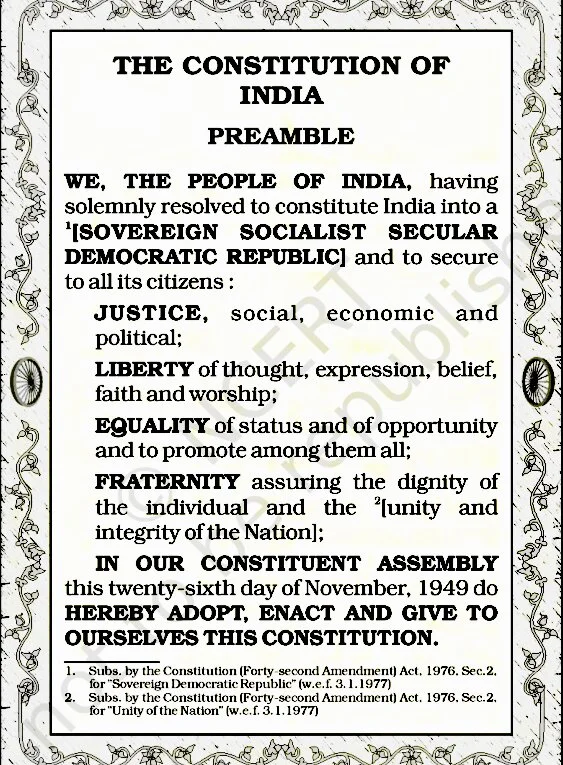
Q15. Explain the Preamble of the Indian Constitution and its ingredients.
BASICThe Preamble expresses the philosophy and broad objectives of the Constitution.
It begins with the words “We, the People of India”, indicating popular sovereignty.
Major constitutional ideals include:
- Sovereign
- Socialist
- Secular
- Democratic
- Republic
- Justice
- Liberty
- Equality
- Fraternity
- Unity and integrity of the nation
Q16. Explain the important words used in the Preamble.
INTERMEDIATE- Sovereign: India is internally supreme and externally independent.
- Socialist: The constitutional vision seeks social and economic justice and reduction of inequality while operating within India’s democratic framework.
- Secular: The State does not establish a theocratic religion and constitutional protection is given to freedom of conscience and religion.
- Democratic: Political authority derives legitimacy through democratic institutions.
- Republic: The head of State is elected, not a hereditary monarch.
- Justice: Social, economic and political justice.
- Liberty: Liberty of thought, expression, belief, faith and worship.
- Equality: Equality of status and opportunity.
- Fraternity: Promotes dignity of the individual and unity and integrity of the nation.
Q17. Is the Preamble a part of the Constitution? Explain its amendability.
EXPERTThe Supreme Court’s constitutional jurisprudence recognises the Preamble as part of the Constitution and an important guide to constitutional interpretation.
The Preamble was amended once, by the 42nd Constitutional Amendment Act, 1976.
The words “Socialist”, “Secular” and “integrity” were added through that amendment.
However, the power to amend the Preamble is not unlimited. Constitutional amendment remains subject to the Basic Structure doctrine.
Q18. Explain the meaning of “India, that is Bharat, shall be a Union of States.”
BASICArticle 1 describes India as a Union of States.
The expression “Union” indicates that the Indian federation is not the result of an agreement among sovereign States. The constitutional Union is indestructible in character, while Parliament has extensive power to reorganise internal territorial units according to constitutional procedures.
Q19. Explain Parliament’s power to reorganise States.
ADVANCEDUnder Articles 2 and 3, Parliament has constitutional power to deal with the admission or establishment of new States and the formation or alteration of existing States in the manner provided by the Constitution.
Parliament may, subject to constitutional procedure:
- Form a new State.
- Increase the area of a State.
- Diminish the area of a State.
- Alter State boundaries.
- Alter the name of a State.
The President refers a Bill under Article 3 to the concerned State Legislature for expressing its views. The State Legislature’s view is not a binding veto over Parliament’s decision.
Q20. Explain the evolution of States and Union Territories after independence.
ADVANCEDThe territorial organisation of India evolved through several stages. Initially, inherited administrative categories existed. The demand for linguistic reorganisation subsequently became important.
The States Reorganisation Act, 1956 and the Seventh Constitutional Amendment were major milestones in reorganising States largely around linguistic and administrative considerations.
Later decades witnessed creation, merger, division and renaming of several States and Union Territories.
Q21. Explain the constitutional issue relating to the India-Bangladesh territorial exchange.
EXPERTThe constitutional position regarding acquisition or transfer of territory has been shaped by constitutional amendments and Supreme Court interpretation.
The 9th Constitutional Amendment Act, 1960 was associated with implementation of the India-Pakistan agreement concerning Berubari.
The later 100th Constitutional Amendment Act, 2015 implemented the India-Bangladesh Land Boundary Agreement and related arrangements concerning enclaves and territories.
Q22. Explain the meaning and significance of citizenship in India.
BASICCitizenship represents full membership of the political community of the State.
Citizens enjoy constitutional and statutory rights and owe legal obligations to the State.
India follows the principle of single citizenship. A person is a citizen of India rather than simultaneously possessing a separate constitutional citizenship of an individual State.
Q23. Explain the constitutional provisions relating to citizenship.
INTERMEDIATEArticles 5 to 11 deal with citizenship at the commencement of the Constitution and Parliament’s power concerning citizenship.
- Article 5 – Citizenship at commencement.
- Article 6 – Rights of citizenship of certain persons who migrated from Pakistan to India.
- Article 7 – Certain migrants to Pakistan.
- Article 8 – Persons of Indian origin residing outside India.
- Article 9 – Voluntary acquisition of foreign citizenship.
- Article 10 – Continuance of citizenship rights.
- Article 11 – Parliament’s power to regulate citizenship.
Q24. Explain the Citizenship Act, 1955 and the major modes of acquiring citizenship.
ADVANCEDThe Citizenship Act, 1955 provides statutory rules concerning acquisition and termination of citizenship.
Major modes of acquisition include:
- By birth
- By descent
- By registration
- By naturalisation
- By incorporation of territory
Citizenship may cease through:
- Renunciation
- Termination
- Deprivation
Q25. Explain Overseas Citizenship of India (OCI).
ADVANCEDOCI is a statutory immigration and registration facility available to eligible persons of Indian origin under the Citizenship Act framework.
OCI status should not be confused with full Indian citizenship.
An OCI cardholder does not become an Indian citizen merely because the person holds OCI status.
Q26. Explain the major features of Fundamental Rights.
BASIC- They are constitutionally guaranteed.
- They protect important aspects of individual liberty and equality.
- Some rights are available only to citizens, while some are available to all persons.
- They are subject to constitutionally permitted reasonable restrictions where applicable.
- Courts can enforce them.
- Article 32 provides a constitutional remedy before the Supreme Court.
- Judicial review protects constitutional rights against unconstitutional State action.
Q27. Explain the meaning of “State” under Article 12.
INTERMEDIATEArticle 12 defines “State” for the purpose of Part III.
It includes:
- Government and Parliament of India.
- Government and Legislature of each State.
- Local authorities.
- Other authorities within the territory of India or under the control of the Government of India.
The purpose is to ensure that Fundamental Rights operate against constitutionally relevant governmental or public authorities within the meaning of Part III.
Q28. Explain Article 13 and laws inconsistent with Fundamental Rights.
ADVANCEDArticle 13 establishes an important constitutional principle: laws that are inconsistent with the Fundamental Rights are subject to constitutional scrutiny to the extent of their inconsistency.
This provision forms an important basis for judicial review of legislation and executive action affecting Fundamental Rights.
Right to Equality – Articles 14 to 18
Q29. Explain the Right to Equality in detail.
ADVANCED- Article 14: Equality before law and equal protection of laws.
- Article 15: Prohibits discrimination on specified grounds and permits constitutionally authorised affirmative measures.
- Article 16: Equality of opportunity in public employment, subject to constitutional exceptions and reservations.
- Article 17: Abolishes untouchability.
- Article 18: Abolishes titles except military and academic distinctions within the constitutional framework.
Right to Freedom – Articles 19 to 22
Q30. Explain the six freedoms under Article 19.
INTERMEDIATE- Freedom of speech and expression.
- Freedom to assemble peacefully and without arms.
- Freedom to form associations or unions or cooperative societies.
- Freedom to move freely throughout India.
- Freedom to reside and settle in any part of India.
- Freedom to practise any profession or carry on any occupation, trade or business.
These freedoms are subject to constitutionally authorised reasonable restrictions.
Q31. Explain the significance of Article 21 and the development of the Right to Life and Personal Liberty.
EXPERTArticle 21 states that no person shall be deprived of life or personal liberty except according to procedure established by law.
Judicial interpretation has expanded Article 21 substantially. It has been used to recognise several dimensions of dignified life, liberty and procedural fairness.
The Supreme Court’s constitutional jurisprudence treats Article 21 as one of the central protections in the Fundamental Rights framework. 4/p>
Right Against Exploitation
Q32. Explain the Right Against Exploitation.
BASIC- Article 23: Prohibits trafficking in human beings, begar and other similar forms of forced labour, subject to constitutional provisions.
- Article 24: Prohibits employment of children below the constitutionally specified age in factories, mines or other hazardous employment.
Right to Freedom of Religion
Q33. Explain Articles 25 to 28 relating to Freedom of Religion.
INTERMEDIATE- Article 25: Freedom of conscience and free profession, practice and propagation of religion, subject to constitutional limitations.
- Article 26: Freedom to manage religious affairs subject to constitutional limitations.
- Article 27: Freedom regarding payment of taxes for promotion of a particular religion.
- Article 28: Religious instruction in educational institutions is regulated according to the constitutional framework.
Cultural and Educational Rights
Q34. Explain Cultural and Educational Rights under Articles 29 and 30.
INTERMEDIATE- Article 29 protects specified cultural and linguistic interests.
- Article 30 gives minorities the right to establish and administer educational institutions of their choice, subject to constitutional interpretation and regulation.
Right to Constitutional Remedies and Writs
Q35. Explain the Right to Constitutional Remedies and the five writs.
EXPERTArticle 32 empowers the Supreme Court to issue directions, orders or writs for enforcement of Fundamental Rights.
| Writ | Basic Purpose |
|---|---|
| Habeas Corpus | Protection against unlawful detention. |
| Mandamus | Commands a public authority to perform a public/legal duty. |
| Prohibition | Prevents a lower court/tribunal from exceeding jurisdiction. |
| Certiorari | Used to quash certain orders/proceedings of lower courts or tribunals when legal conditions are satisfied. |
| Quo Warranto | Challenges unlawful occupation of a public office. |
Q36. Explain the position of Fundamental Rights of Armed Forces and the constitutional concept of Martial Law.
EXPERTArticle 33 permits Parliament to modify the application of Fundamental Rights to members of the armed forces, forces maintaining public order, intelligence organisations and related services to ensure proper discharge of duties and maintenance of discipline.
Article 34 concerns restrictions on Fundamental Rights while martial law is in force in any area within the territory of India.
Important distinction: Martial law is not the same constitutional concept as a National Emergency.
Q37. Explain the present position of the Right to Property.
ADVANCEDThe Right to Property was originally a Fundamental Right under Articles 19 and 31.
The 44th Constitutional Amendment Act, 1978 removed it from the list of Fundamental Rights.
It is now protected under Article 300A as a constitutional legal right: no person shall be deprived of property save by authority of law.
Q38. Discuss the significance and criticisms of Fundamental Rights.
ADVANCEDSignificance:
- Protect individual liberty.
- Promote equality.
- Limit arbitrary State action.
- Protect democratic participation.
- Provide judicially enforceable guarantees.
Criticisms:
- Several rights are subject to restrictions.
- The legal language can be complex.
- Access to constitutional remedies may require legal knowledge and resources.
- Rights can come into tension with public order, security and social reform objectives.
Q39. Explain the features of the Directive Principles of State Policy.
BASIC- Contained in Part IV of the Constitution.
- They guide the State in making laws and policies.
- They are not enforceable by courts in the same manner as Fundamental Rights.
- They aim at establishing social and economic democracy.
- They are fundamental to governance of the country.
Q40. Classify the Directive Principles of State Policy.
INTERMEDIATECommon textbook classification:
| Category | Examples |
|---|---|
| Socialistic principles | Social and economic justice, adequate livelihood, equal pay, public assistance, workers’ welfare and related objectives. |
| Gandhian principles | Village panchayats, cottage industries, weaker sections, prohibition and other Gandhian objectives. |
| Liberal-intellectual principles | Uniform Civil Code, separation of judiciary from executive, international peace, protection of environment and related principles. |
Q41. Explain the new Directive Principles added through constitutional amendments.
ADVANCED- Article 39A: Equal justice and free legal aid.
- Article 43A: Participation of workers in management of industries.
- Article 48A: Protection and improvement of environment and safeguarding forests and wildlife.
These were added through constitutional amendments to expand the social, economic and environmental objectives of the Constitution.
Q42. Explain the conflict and relationship between Fundamental Rights and Directive Principles.
EXPERTFundamental Rights and Directive Principles serve different but complementary constitutional purposes.
Fundamental Rights primarily provide enforceable individual and group protections, while Directive Principles establish goals for social and economic transformation.
Constitutional jurisprudence has progressively emphasised harmonising the two rather than treating them as permanently opposed.
The Supreme Court has described Parts III and IV as complementary and as important components of the constitutional conscience. 5/p>
Q43. Discuss the utility and implementation of Directive Principles.
ADVANCEDAlthough Directive Principles are non-justiciable, they have influenced legislation, welfare policies, labour laws, education, public health, environmental policy and social justice measures.
They provide a constitutional policy compass for governments.
Q44. Explain the origin and significance of Fundamental Duties.
INTERMEDIATEFundamental Duties were added to the Constitution through the 42nd Constitutional Amendment Act, 1976, following the recommendations of the Swaran Singh Committee.
They are contained in Article 51A.
The original Constitution did not contain a separate list of Fundamental Duties.
Q45. List the Fundamental Duties under Article 51A.
BASIC- Respect the Constitution, National Flag and National Anthem.
- Cherish ideals of the freedom struggle.
- Uphold and protect sovereignty, unity and integrity of India.
- Defend the country and render national service when called upon.
- Promote harmony and brotherhood and renounce practices derogatory to the dignity of women.
- Value and preserve the rich heritage of India’s composite culture.
- Protect and improve the natural environment and have compassion for living creatures.
- Develop scientific temper, humanism and the spirit of inquiry and reform.
- Safeguard public property and abjure violence.
- Strive towards excellence in all spheres of individual and collective activity.
- Provide opportunities for education to a child/ward between six and fourteen years of age, as constitutionally prescribed for the parent/guardian.
Q46. Explain the criticisms and significance of Fundamental Duties.
ADVANCEDCriticisms:
- They are generally non-justiciable as Fundamental Duties by themselves.
- Some duties are expressed in broad language.
- They were added after the original Constitution.
Significance:
- They remind citizens that constitutional democracy involves responsibilities as well as rights.
- They promote national unity and civic discipline.
- They encourage environmental protection and scientific temper.
- They can assist courts in interpreting laws and constitutional values where legally relevant.
Q47. Why does the Constitution need an amendment procedure?
BASICA Constitution must provide stability but also allow adaptation to changing social, economic and political circumstances.
The Indian Constitution therefore provides different amendment procedures depending on the importance and nature of the provision being changed.
Q48. Explain the three broad methods of constitutional amendment in India.
ADVANCEDType 1 – Simple Majority:
Certain provisions can be changed by ordinary legislative procedure and are not treated as amendments under Article 368 in the strict sense.
Type 2 – Special Majority:
Most constitutional amendments require a majority of the total membership of each House plus a majority of not less than two-thirds of members present and voting.
Type 3 – Special Majority + State Ratification:
Certain federal provisions additionally require ratification by at least one-half of the State Legislatures.
Q49. Explain the criticisms of the Indian amendment procedure.
ADVANCED- It is complex because different provisions follow different procedures.
- The distinction between provisions amendable by different methods can be difficult for students to memorise.
- Critics argue that Parliament has considerable amendment power.
- At the same time, the Basic Structure doctrine limits the power of constitutional amendment.
Q50. Explain the emergence of the Basic Structure Doctrine.
EXPERTThe Basic Structure Doctrine emerged through a series of constitutional cases, culminating in the landmark Kesavananda Bharati v. State of Kerala (1973) decision.
The Supreme Court held that Parliament’s power to amend the Constitution is wide but cannot be used to destroy its basic structure or essential constitutional identity.
The doctrine therefore creates a constitutional limitation on the amending power.
The Supreme Court’s own case materials identify Kesavananda Bharati as the landmark decision associated with the Basic Structure Doctrine. 6/p>
Q51. What are the major elements of the Basic Structure?
EXPERTThe Supreme Court has identified various features as part of the basic structure through different cases. The list is not a closed statutory list.
Important features recognised through constitutional jurisprudence include:
- Supremacy of the Constitution.
- Republican and democratic form of government.
- Secular character of the Constitution.
- Federal character.
- Separation of powers.
- Rule of law.
- Judicial review.
- Independence of judiciary.
- Dignity and freedom of the individual.
- Constitutional supremacy.
- Free and fair elections.
- Unity and integrity of India.
- Parliamentary democracy.
The Supreme Court has specifically reproduced the classic Kesavananda formulation including constitutional supremacy, republican and democratic government, secularism, separation of powers and federalism. 7/p>
Q52. Explain why the Basic Structure Doctrine is important for Indian democracy.
EXPERTWithout a limitation on constitutional amendment, a temporary parliamentary majority could theoretically attempt to fundamentally alter the identity of the constitutional system.
The Basic Structure Doctrine preserves the distinction between:
- Amending the Constitution
- Destroying the Constitution’s fundamental identity
It therefore attempts to balance constitutional flexibility with constitutional continuity.
Section II – Interactive MCQs
1. Which Act was the first major parliamentary attempt to regulate the East India Company?
2. Who became the first Governor-General of Bengal?
3. Which Act ended the East India Company’s rule in India?
4. The Constituent Assembly was formed under which plan?
5. Who was the Chairman of the Drafting Committee?
6. The Constitution was adopted on:
7. The Constitution came into force on:
8. Which part of the Constitution contains Fundamental Rights?
9. Which Article defines “State” for Fundamental Rights?
10. Which Article guarantees equality before law and equal protection of laws?
11. Which Article abolishes untouchability?
12. Which Article contains the Right to Constitutional Remedies?
13. Which writ literally means “produce the body”?
14. Right to Property is currently:
15. Directive Principles are contained in:
16. Fundamental Duties are contained in:
17. Fundamental Duties were added by which amendment?
18. Which amendment added the Fundamental Duty relating to education of children aged 6–14?
19. Which amendment added “Socialist” and “Secular” to the Preamble?
20. The Basic Structure Doctrine is principally associated with:
Section III – Assertion & Reasoning
A. Both Assertion and Reason are true, and Reason correctly explains Assertion.
B. Both Assertion and Reason are true, but Reason does not correctly explain Assertion.
C. Assertion is true, but Reason is false.
D. Assertion is false, but Reason is true.
Assertion 1
Assertion (A): The Government of India Act, 1858 ended Company rule in India.
Reason (R): The Act transferred the administration of India to the British Crown.
Assertion 2
Assertion (A): The Constitution was adopted on 26 November 1949.
Reason (R): The Constitution came into force completely on 26 November 1949.
Assertion 3
Assertion (A): The Preamble can be amended.
Reason (R): The Preamble is completely outside the Constitution.
Assertion 4
Assertion (A): Right to Property is no longer a Fundamental Right.
Reason (R): The 44th Amendment removed it from the Fundamental Rights chapter.
Assertion 5
Assertion (A): Fundamental Duties were part of the original Constitution.
Reason (R): The 42nd Amendment added Fundamental Duties in 1976.
Assertion 6
Assertion (A): Directive Principles are not enforceable by courts in the same manner as Fundamental Rights.
Reason (R): They are intended to guide the State in governance and policy-making.
Assertion 7
Assertion (A): Parliament can amend every constitutional provision without limitation.
Reason (R): The Basic Structure Doctrine places a limitation on constitutional amendment.
Section IV – Match the Column
Match the Column – 1: Historical Background
| Column A | Column B |
|---|---|
| 1. Regulating Act | A. 1858 |
| 2. Government of India Act | B. 1773 |
| 3. Government of India Act | C. 1935 |
| 4. Indian Independence Act | D. 1947 |
Regulating Act → 1773
Government of India Act → 1858
Government of India Act → 1935
Indian Independence Act → 1947
Match the Column – 2: Constitution Making
| Column A | Column B |
|---|---|
| 1. Drafting Committee | A. B.N. Rau |
| 2. Constitutional Adviser | B. Dr. B.R. Ambedkar |
| 3. President of Constituent Assembly | C. Rajendra Prasad |
| 4. Permanent Chairman | D. Rajendra Prasad |
Drafting Committee → B.R. Ambedkar
Constitutional Adviser → B.N. Rau
President of Constituent Assembly → Rajendra Prasad
Match the Column – 3: Fundamental Rights
| Column A | Column B |
|---|---|
| 1. Article 14 | A. Freedom of Religion |
| 2. Article 17 | B. Equality before Law |
| 3. Article 25 | C. Abolition of Untouchability |
| 4. Article 32 | D. Constitutional Remedies |
Article 14 → Equality
Article 17 → Abolition of Untouchability
Article 25 → Freedom of Religion
Article 32 → Constitutional Remedies
Match the Column – 4: Constitutional Parts
| Column A | Column B |
|---|---|
| 1. Part III | A. Fundamental Duties |
| 2. Part IV | B. Fundamental Rights |
| 3. Part IVA | C. Directive Principles |
| 4. Part I | D. Union and its Territory |
Part III → Fundamental Rights
Part IV → Directive Principles
Part IVA → Fundamental Duties
Part I → Union and its Territory
Match the Column – 5: Amendment & Basic Structure
| Column A | Column B |
|---|---|
| 1. 42nd Amendment | A. Right to Property changed |
| 2. 44th Amendment | B. Fundamental Duties |
| 3. Kesavananda Bharati | C. Basic Structure |
| 4. Article 368 | D. Constitutional Amendment |
42nd Amendment → Fundamental Duties
44th Amendment → Right to Property changed
Kesavananda Bharati → Basic Structure
Article 368 → Constitutional Amendment
Final Advanced Revision – Constitutional Framework
High-Value Article & Concept Map
| Article / Provision | Concept |
|---|---|
| Article 1 | India/Bharat – Union of States |
| Articles 2–3 | Admission, establishment and reorganisation of States |
| Articles 5–11 | Citizenship |
| Article 12 | Definition of State |
| Article 13 | Laws inconsistent with Fundamental Rights |
| Articles 14–18 | Right to Equality |
| Articles 19–22 | Right to Freedom |
| Articles 23–24 | Right Against Exploitation |
| Articles 25–28 | Freedom of Religion |
| Articles 29–30 | Cultural and Educational Rights |
| Article 32 | Constitutional Remedies |
| Articles 36–51 | Directive Principles |
| Article 51A | Fundamental Duties |
| Article 300A | Right to Property as a constitutional legal right |
| Article 368 | Constitutional amendment |
Master Concept: How Part I Connects Together
Historical Background explains how the constitutional institutions developed.
↓
Constituent Assembly explains who framed the Constitution and how it was prepared.
↓
Concept of Constitution explains what a Constitution does.
↓
Salient Features explains the architecture of the Indian constitutional system.
↓
Preamble explains the constitutional philosophy and goals.
↓
Union and Territory + Citizenship defines the territorial and political community.
↓
Fundamental Rights protect citizens/persons against unconstitutional State action.
↓
Directive Principles establish social and economic objectives.
↓
Fundamental Duties establish constitutional responsibilities of citizens.
↓
Amendment allows constitutional adaptation.
↓
Basic Structure prevents amendment from destroying the Constitution’s fundamental identity.
Constitution = Structure + Rights + Governance + Goals + Duties + Amendment + Basic Structure
Preamble = Constitutional Philosophy
Fundamental Rights = Individual Protection
Directive Principles = Social Transformation
Fundamental Duties = Citizen Responsibility
Amendment = Constitutional Change
Basic Structure = Constitutional Identity Protection