
THE INDIAN CONSTITUTION
Parts • Articles 1–395 • Schedules • Important Provisions • Practice Questions
UPSC / OPSC / State PSC / Competitive Examination Study Resource
1. What is a Constitution?
A Constitution is the fundamental framework of a country. It establishes the structure of government, distributes powers among institutions, defines the relationship between the State and citizens and lays down basic principles under which public authority operates.
The Constitution of India was adopted on 26 November 1949 and came into force on 26 January 1950. It provides the constitutional framework for India’s democratic system, Fundamental Rights, Directive Principles, institutions of government, federal relations, elections, emergency provisions and constitutional amendment.
2. Salient Features of the Indian Constitution
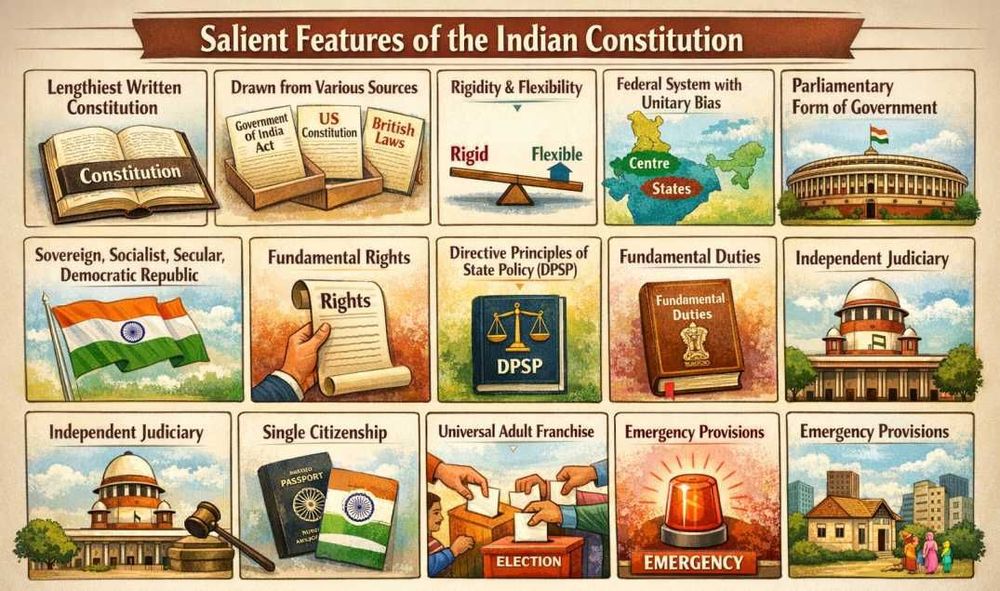
1. Lengthy Written Constitution
The Constitution contains detailed provisions relating to government, citizenship, rights, administration, federal relations and several other constitutional subjects.
2. Drawn from Various Sources
Several institutional features were influenced by constitutional experiences of other countries. Examples include the parliamentary system associated with the United Kingdom, Fundamental Rights influenced by the United States, Directive Principles influenced by Ireland and aspects of the federal system influenced by Canada.
3. Combination of Rigidity and Flexibility
Different provisions are amended through different procedures. Some can be changed by a simple majority, while others require a special majority and, for specified matters, ratification by at least half of the State Legislatures.
4. Federal System with a Strong Union
Powers are constitutionally distributed between the Union and the States. At the same time, the Constitution contains provisions that give the Union significant authority in specified circumstances.
5. Parliamentary Form of Government
India follows a parliamentary system. The President is the constitutional head of the Union, while the Council of Ministers headed by the Prime Minister exercises executive authority subject to constitutional provisions and parliamentary responsibility.
6. Sovereign, Socialist, Secular, Democratic Republic
These expressions form part of the Preamble and describe fundamental constitutional commitments of the Republic of India.
7. Fundamental Rights
Part III contains Fundamental Rights including equality, freedoms, protection against exploitation, freedom of religion, cultural and educational rights and constitutional remedies.
8. Directive Principles of State Policy
Part IV contains principles intended to guide the State in governance and policy-making. They are not enforceable by courts but are fundamental in the governance of the country.
9. Fundamental Duties
Article 51A contains Fundamental Duties of citizens. They were introduced through the 42nd Constitutional Amendment.
10. Independent Judiciary
The Constitution establishes an independent judicial system headed by the Supreme Court. Judicial review enables constitutional courts to examine the constitutional validity of laws and governmental action.
11. Single Citizenship
The constitutional system provides for single citizenship rather than separate constitutional citizenship of the Union and individual States.
12. Universal Adult Suffrage
Citizens who satisfy the constitutional and statutory requirements for registration as electors participate in elections. The voting age is 18 years.
13. Emergency Provisions
Part XVIII contains provisions concerning National Emergency, failure of constitutional machinery in States and Financial Emergency.
14. Special Provisions for Certain Classes
The Constitution contains safeguards and special provisions concerning specified classes and communities, including provisions concerning Scheduled Castes, Scheduled Tribes and other constitutionally recognised groups.
15. Local Self-Government
Parts IX and IX-A contain constitutional provisions relating to Panchayats and Municipalities respectively. Part IX-B deals with co-operative societies.
3. PARTS OF THE INDIAN CONSTITUTION
| Part | Subject / Area | Articles |
|---|---|---|
| Part I | The Union and its Territory | 1–4 |
| Part II | Citizenship | 5–11 |
| Part III | Fundamental Rights | 12–35 |
| Part IV | Directive Principles of State Policy | 36–51 |
| Part IV-A | Fundamental Duties | 51A |
| Part V | The Union | 52–151 |
| Part VI | The States | 152–237 |
| Part VII | States in Part B of First Schedule — repealed | Omitted |
| Part VIII | Union Territories | 239–242 |
| Part IX | The Panchayats | 243–243O |
| Part IX-A | The Municipalities | 243P–243ZG |
| Part IX-B | Co-operative Societies | 243ZH–243ZT |
| Part X | Scheduled and Tribal Areas | 244–244A |
| Part XI | Relations between the Union and the States | 245–263 |
| Part XII | Finance, Property, Contracts and Suits | 264–300A |
| Part XIII | Trade, Commerce and Intercourse within India | 301–307 |
| Part XIV | Services under the Union and the States | 308–323 |
| Part XIV-A | Tribunals | 323A–323B |
| Part XV | Elections | 324–329A |
| Part XVI | Special Provisions Relating to Certain Classes | 330–342A |
| Part XVII | Official Language | 343–351 |
| Part XVIII | Emergency Provisions | 352–360 |
| Part XIX | Miscellaneous | 361–367 |
| Part XX | Amendment of the Constitution | 368 |
| Part XXI | Temporary, Transitional and Special Provisions | 369–392 |
| Part XXII | Short Title, Commencement, Authoritative Text in Hindi and Repeals | 393–395 |
4. IMPORTANT ARTICLES OF THE INDIAN CONSTITUTION
| Article | Part / Area | Provision / Explanation |
|---|
5. SCHEDULES OF THE INDIAN CONSTITUTION
| Schedule | Subject / Area | Key Points |
|---|---|---|
| First Schedule | States and Union Territories | Names of States and Union Territories and their territorial extent. |
| Second Schedule | Salaries, allowances and related provisions | Constitutional authorities including the President, Governors, presiding officers, Judges and CAG. |
| Third Schedule | Oaths and affirmations | Forms of oaths and affirmations for specified constitutional offices and legislators. |
| Fourth Schedule | Allocation of seats in the Council of States | Allocation of Rajya Sabha seats to States and Union Territories. |
| Fifth Schedule | Scheduled Areas and Scheduled Tribes | Administration and control of Scheduled Areas and Scheduled Tribes. |
| Sixth Schedule | Tribal Areas | Special administrative arrangements for specified tribal areas in Assam, Meghalaya, Tripura and Mizoram. |
| Seventh Schedule | Distribution of legislative subjects | Union List, State List and Concurrent List. |
| Eighth Schedule | Languages | Languages recognised in the Eighth Schedule; currently 22 languages. |
| Ninth Schedule | Specified laws | Contains laws placed in the Schedule under constitutional provisions; judicial review of Ninth Schedule laws is subject to constitutional jurisprudence. |
| Tenth Schedule | Anti-defection | Disqualification of certain legislators on grounds of defection. |
| Eleventh Schedule | Panchayats | 29 subjects associated with Panchayati Raj institutions. |
| Twelfth Schedule | Municipalities | 18 subjects associated with Municipalities. |